Nano Banana 2.1 vs GPT Image 2.5: 8 Side-by-Side API Tests
- 1. Quick Verdict
- 2. How We Tested
- 3. Text Rendering
- 4. Prompt Adherence: The Counting Test
- 5. Editing With Reference Images
- 6. Photorealism
- 7. Wide 21:9 Landscapes
- 8. Speed and Price
- 9. Which One Should You Use?
- 10. FAQ
- 11. Sources
1. Quick Verdict
Google's Nano Banana 2.1 (October 2026) and OpenAI's GPT Image 2.5 (September 2026) are the two newest general-purpose image models. We ran both through the GoEnhance API with the same eight prompts and a matched price per image, and compared the results side by side. Short version: they are close on accuracy, GPT Image 2.5 produces richer, more styled scenes, and Nano Banana 2.1 is about five times faster and sticks more closely to what you asked for.
| Nano Banana 2.1 | GPT Image 2.5 (Sunburst, high) | |
|---|---|---|
| Text spelling (menu, infographic, bilingual poster) | 3 of 3 correct | 3 of 3 correct |
| Added text nobody asked for | Rarely | Often (slogans, labels, a boat number) |
| Counting test (7 apples + 3 pears) | Correct | Correct |
| Kept the character when editing | Yes | Yes |
| Scene richness | Clean, literal | Richer, more art-directed |
| Median time per image (1K, our run) | 18.9 s | 102.8 s |
| API price at 1K (tokens) | 2.92 | 2.84 at high quality (0.32 at low) |
| On GoEnhance studio (1K / 2K / 4K) | 6 / 9 / 17 tokens | 8 / 17 / 29 tokens |
| Transparent background | No | Yes |
| Reference images per edit | Up to 9 | Up to 16 |
2. How We Tested
Every image in this post comes from one API call per model through the GoEnhance image API on October 8, 2026:
- Models:
nano-banana-2-1(andnano-banana-2-1-editfor edits) againstgpt-image-2-5-sunburst, the variant OpenAI recommends when editing precision matters most. - Settings:
image_size1K for both. Nano Banana 2.1 used its default thinking level. GPT Image 2.5 usedquality: high, because at 1K that costs almost exactly the same as Nano Banana 2.1 (2.84 vs 2.92 tokens), so the comparison is fair on price. - Prompts: the same eight prompts we used in our Nano Banana 2.1 vs Nano Banana 2 test, except the wide banner, which uses 21:9 here because GPT Image 2.5 does not offer 8:1.
- Timing: measured from submitting the job to the job reporting success, so it includes queue time. The Nano Banana 2.1 jobs ran earlier the same day.
One run per prompt is not a benchmark. Treat this as a hands-on comparison of how the two models behave on the same input. Sources are listed at the end.
3. Text Rendering
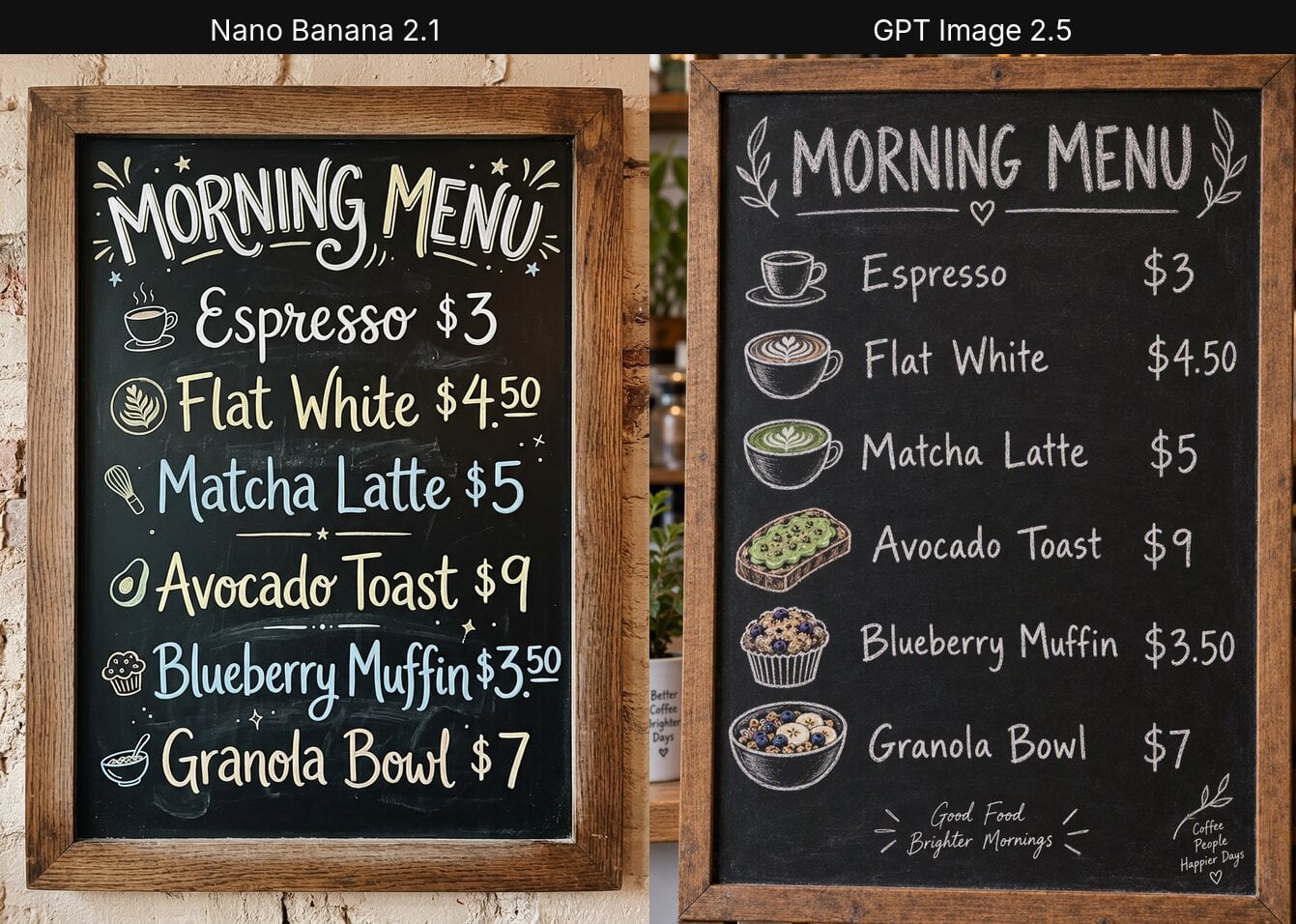
Chalkboard menu. Six items with prices. Both models spelled every item and price correctly. GPT Image 2.5 drew neat food icons, but also added two slogans ("Good Food, Brighter Mornings" and "Coffee People, Happier Days") and text on a cup in the background. Nano Banana 2.1 kept to the six items.
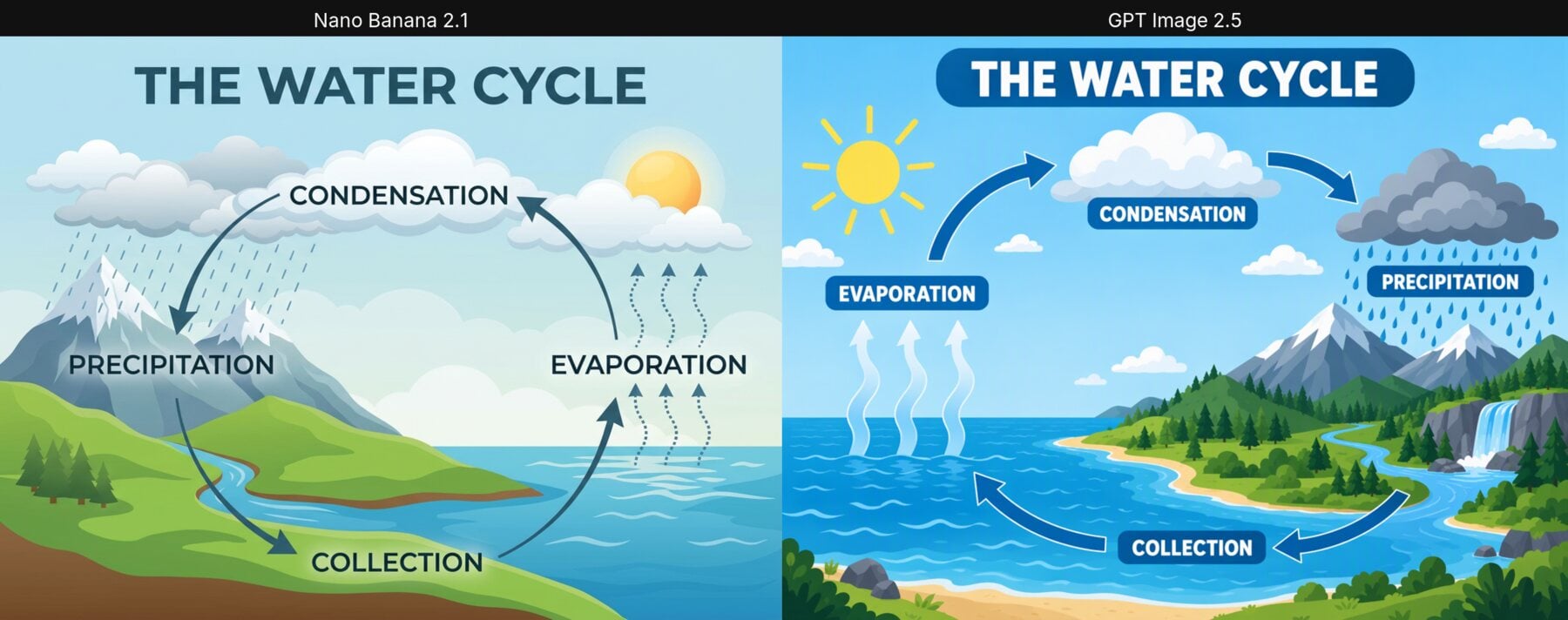
Infographic. "The Water Cycle" with four labelled stages. Both got every label right and drew the cycle in the correct order. GPT Image 2.5's version looks more like a finished textbook graphic, with labels in pill-shaped boxes and a fuller landscape.
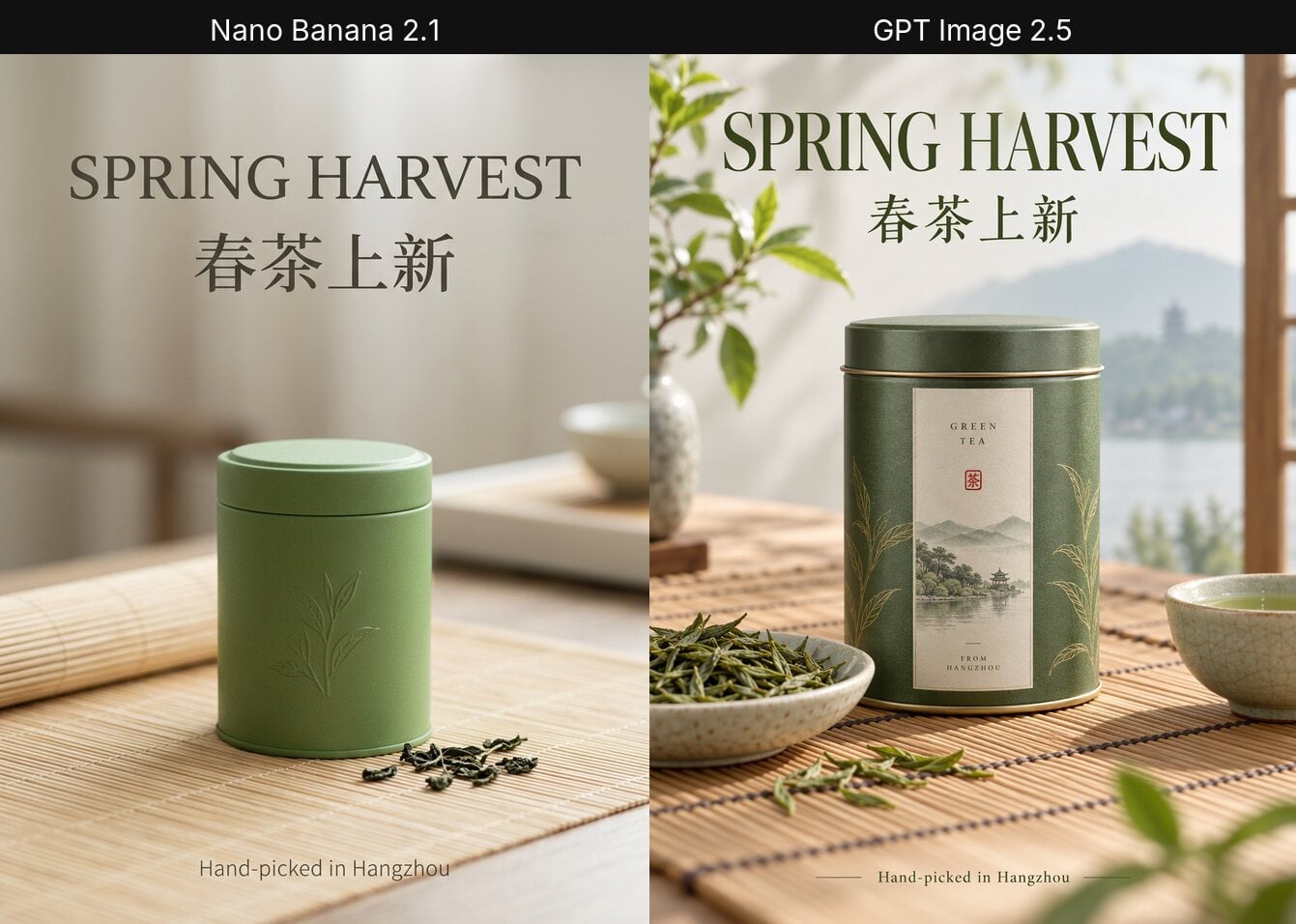
Bilingual poster. An English headline, a Chinese line and a caption, with a minimal layout. Both rendered the English and Chinese correctly. GPT Image 2.5 produced the more attractive poster, but it designed its own tin label ("Green Tea, From Hangzhou" with a seal), which a brand would have to remove. Nano Banana 2.1 left the tin plain, as asked.
Takeaway: for spelling, there is no clear winner. If you want the model to fill in design details, GPT Image 2.5 does more of that; if every word on the image must be yours, Nano Banana 2.1 is easier to control.
4. Prompt Adherence: The Counting Test
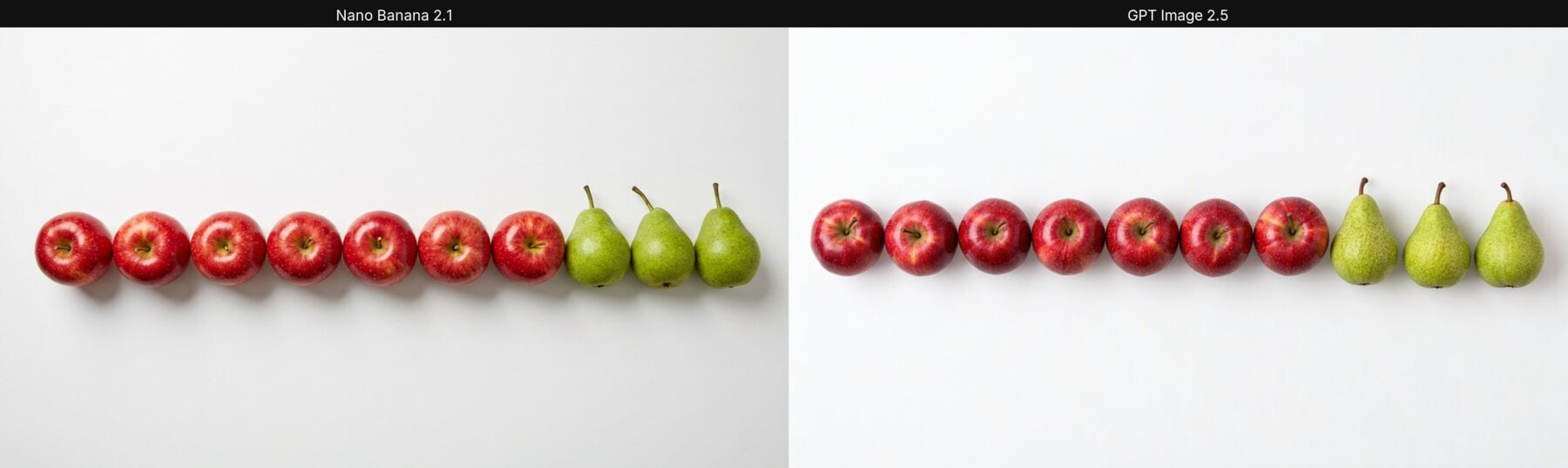
"Exactly seven red apples and three green pears in a single row." Both models got it right. In our earlier test, Nano Banana 2 drew only six apples, so this is a task where both new models have caught up.
5. Editing With Reference Images
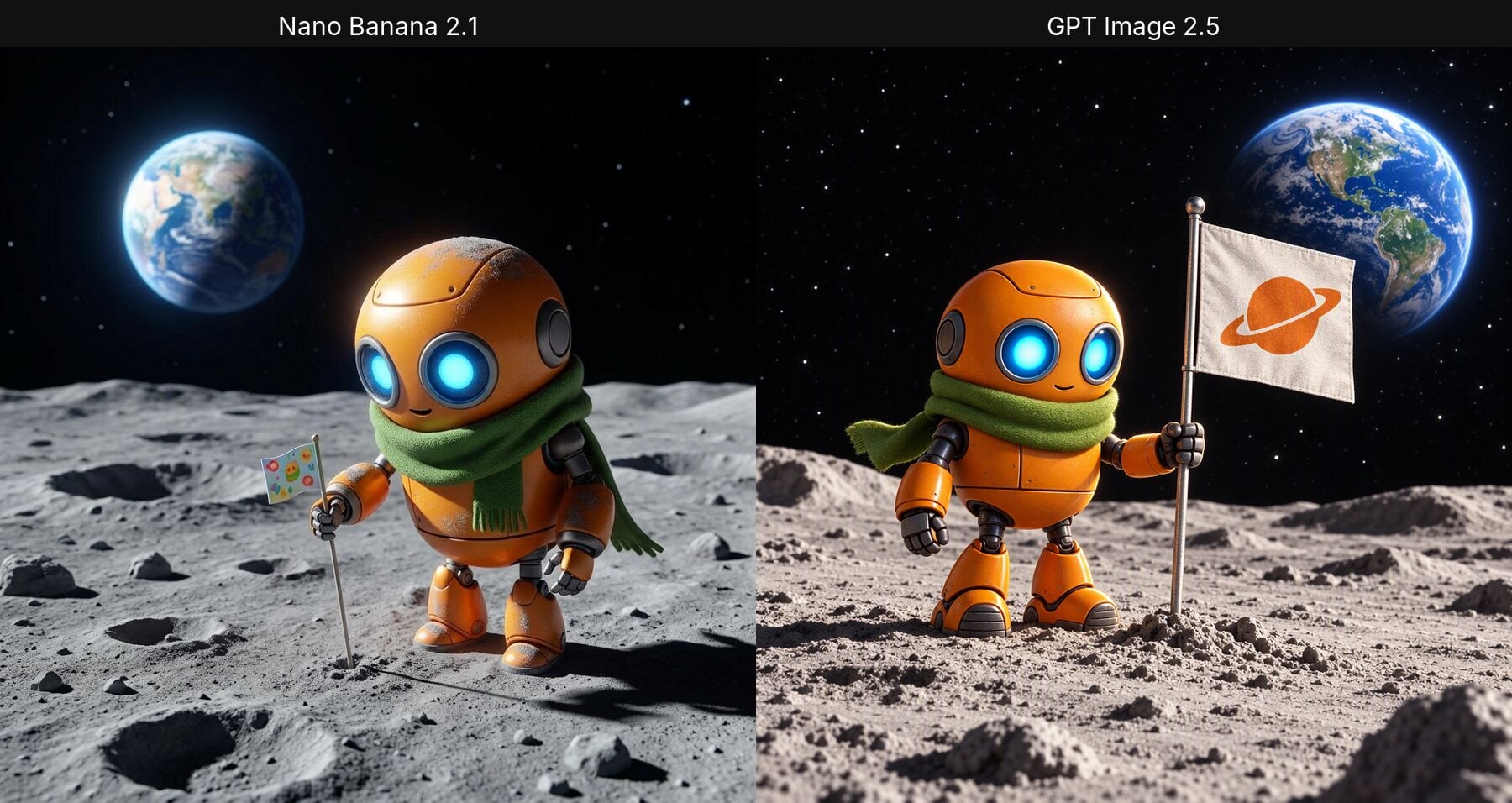
Single reference. We asked both models to take an orange robot from a 2x2 grid and place it alone on the Moon, planting a flag. Both kept the round head, blue eyes and green scarf. GPT Image 2.5 added a large flag with a planet emblem; Nano Banana 2.1 used a small generic flag and added Moon dust to the robot.
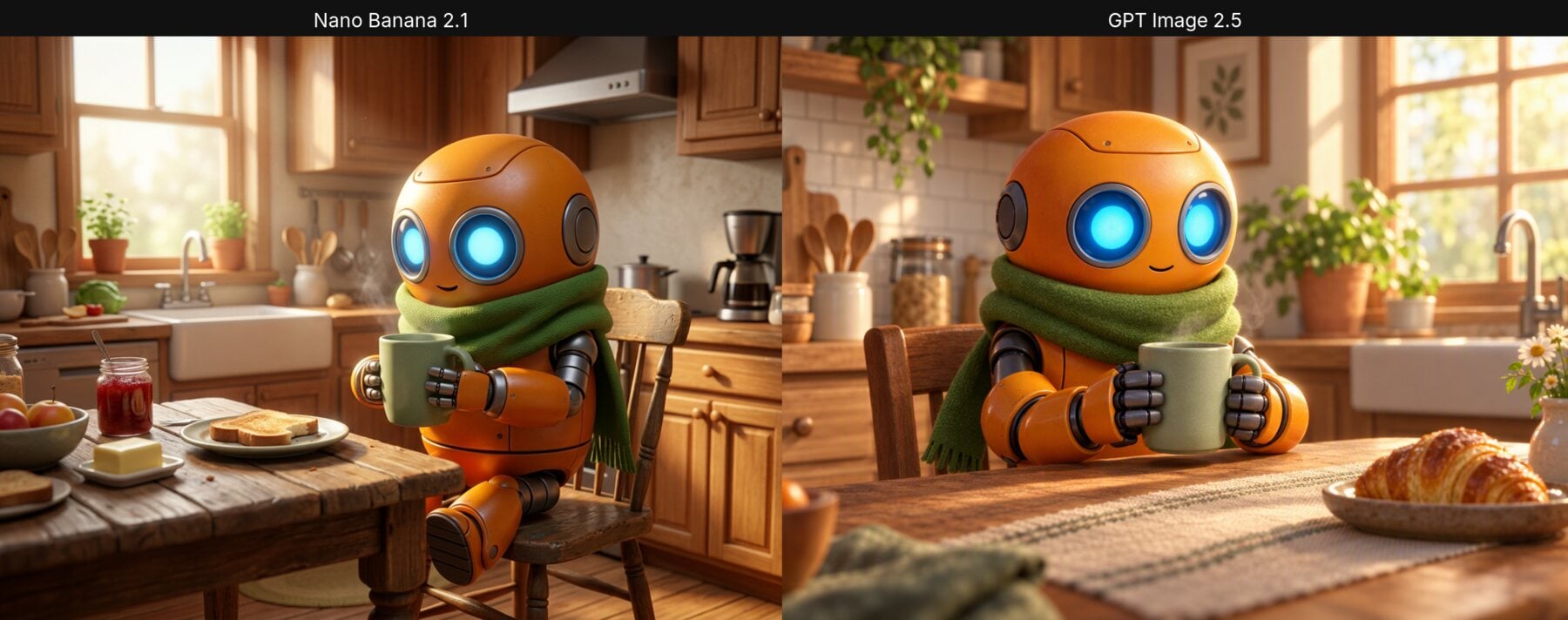
Two references. The robot (image 1) holding a green ceramic mug (image 2) in a kitchen. Both kept the robot and the mug recognisable. GPT Image 2.5 framed it closer and warmer; Nano Banana 2.1 showed more of the room. Call it a tie.
On limits, GPT Image 2.5 accepts up to 16 reference images per edit on the GoEnhance API, against 9 for Nano Banana 2.1.
6. Photorealism
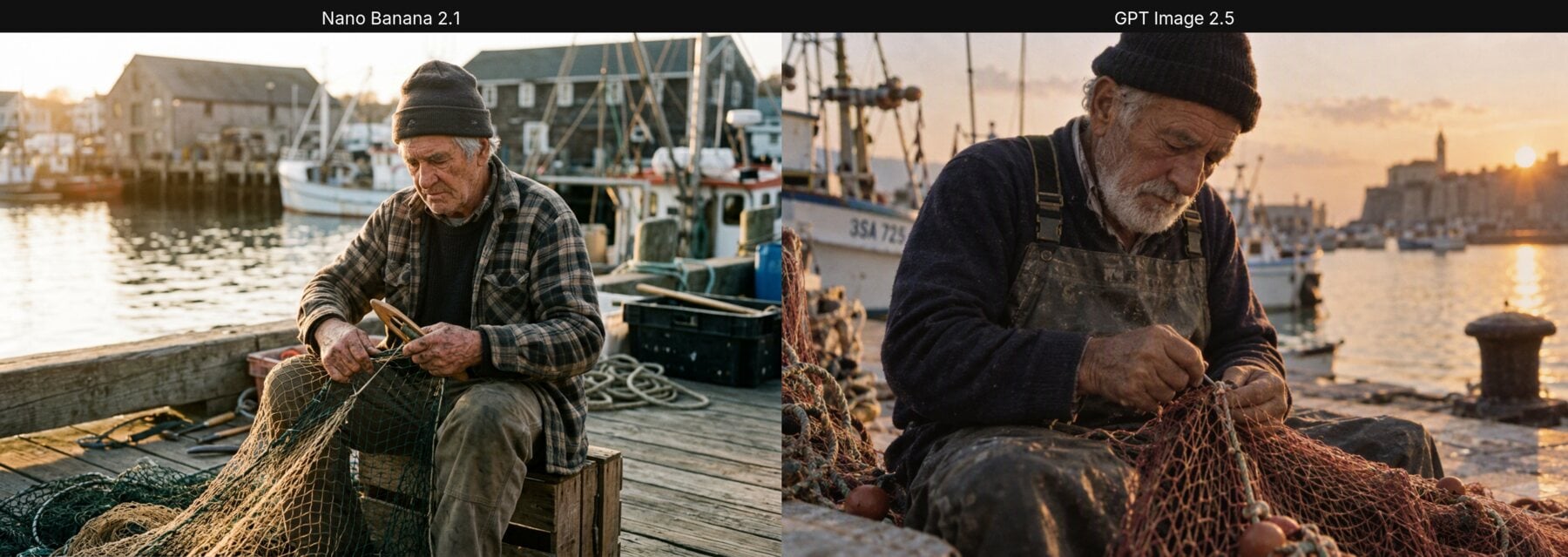
A candid photo of an elderly fisherman mending a net at golden hour. Both are convincing. GPT Image 2.5 went for a darker, more cinematic grade and a tighter crop; Nano Banana 2.1 looks more like a natural documentary photo. GPT Image 2.5 again added text, a registration number on a boat.
7. Wide 21:9 Landscapes
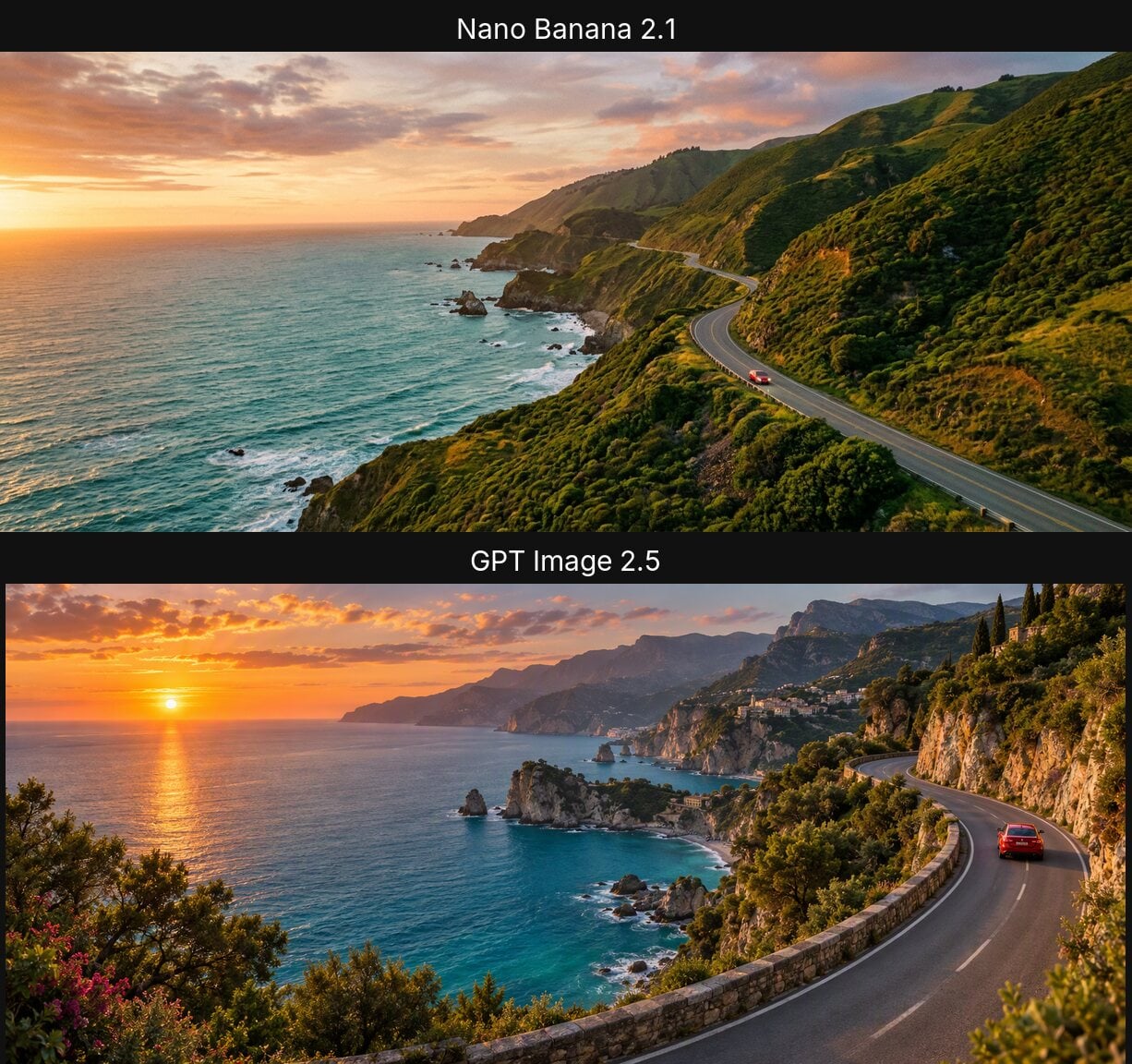
A coastal road at sunset with a single red car. Both produced one coherent panorama. GPT Image 2.5's is busier, with a stone wall, flowers and a hillside village; Nano Banana 2.1's is simpler and more open.
The supported shapes differ. Nano Banana 2.1 also offers the extreme 1:4, 4:1, 1:8 and 8:1 ratios through the API. GPT Image 2.5 offers 1:3, 3:1, 1:2 and 2:1 instead, and OpenAI's own API accepts custom sizes.
8. Speed and Price
Speed is the clearest difference. Across our eight prompts, Nano Banana 2.1 had a median of 18.9 seconds per image (15 to 22 s). GPT Image 2.5 Sunburst at high quality had a median of 102.8 seconds (61 to 111 s). If you need to iterate quickly or generate in bulk, that gap matters more than any single image.
Price depends on how you use GPT Image 2.5, because it is billed by quality as well as resolution. On the GoEnhance API, 1 token = $0.02:
| Setting | Nano Banana 2.1 | GPT Image 2.5 Sunburst |
|---|---|---|
| 1K | 2.92 tokens | 0.32 (low), 0.71 (medium), 2.84 (high) |
| 2K | 4.02 tokens | 0.64 (low), 1.45 (medium), 5.78 (high) |
| 4K | 8.08 tokens | 1.07 (low), 2.4 (medium), 9.61 (high) |
At high quality the two cost about the same at 1K, and Nano Banana 2.1 is cheaper at 2K and 4K. For quick drafts, GPT Image 2.5 at low quality is far cheaper than anything Nano Banana 2.1 offers.
In the GoEnhance studio, Nano Banana 2.1 costs 6, 9 or 17 tokens at 1K, 2K or 4K, with 2K and 4K for members. GPT Image 2.5 costs 8, 17 or 29 tokens; in text-to-image it is for members, and in image-to-image it is open to everyone.
9. Which One Should You Use?
Choose Nano Banana 2.1 if you need speed, you generate a lot at 2K or 4K, or you want the image to contain only the text you wrote. It is the easier model to keep literal.
Choose GPT Image 2.5 if you want the model to art-direct for you, with richer scenes and more finished-looking design, if you need a transparent background, or if you edit with many reference images. Budget for slower generations, and check every image for text you did not ask for.
Use both for posters and ads: draft fast with Nano Banana 2.1, then take the winning idea to GPT Image 2.5 for a styled final version.
For more on each model, see our Nano Banana 2.1 page and GPT Image 2.5 page. If you are upgrading from the previous OpenAI model, the GPT Image 2 page covers what changed, and the ChatGPT image editor and our ChatGPT image prompts are good places to start.
We also tested Nano Banana 2.1 against ByteDance's Seedream 5.0 Pro with the same prompts: see Nano Banana 2.1 vs Seedream 5.0: 8 Side-by-Side API Tests.
10. FAQ
Is Nano Banana 2.1 better than GPT Image 2.5? Neither wins outright. In our test they matched on spelling and counting. GPT Image 2.5 produced richer images; Nano Banana 2.1 was about five times faster and followed instructions more literally.
Which one renders text better? Both spelled every requested word correctly in our three text tests. GPT Image 2.5 tends to add extra text of its own, such as slogans or labels, so check its output before you publish.
Which is cheaper? At 1K and high quality they cost about the same on the GoEnhance API. Nano Banana 2.1 is cheaper at 2K and 4K at that quality, while GPT Image 2.5 at low or medium quality is much cheaper for drafts.
Can I use both through one API?
Yes. On the GoEnhance API the model names are nano-banana-2-1 and nano-banana-2-1-edit for Nano Banana 2.1, and gpt-image-2-5-sunburst or gpt-image-2-5-flare for GPT Image 2.5, all through the same images endpoint.
11. Sources
- OpenAI, Image generation guide: the Sunburst and Flare variants, when to choose each, and transparent backgrounds.
- OpenAI, Image prompting guide: Sunburst as the quality-focused base model and Flare as the speed-focused small model.
- OpenAI, ChatGPT Images 2.5 System Card (September 8, 2026): release date and known limitations.
- Google AI for Developers, Nano Banana 2.1 model page: capabilities, supported ratios and reference image limits.
- GoEnhance API docs, gpt-image-2-5-sunburst and nano-banana-2-1: parameters, reference image limits and per-image prices used in this test.
- Our own test: 16 API jobs run on October 8, 2026, one per prompt and model; every image in this post is unedited apart from resizing and labels.