Popular
Nano Banana Pro
Image20000+ prompts
View prompts
Discover vehicle prompts for performance cars, motorcycles, aircraft, futuristic transport, automotive campaigns, and original concept designs.
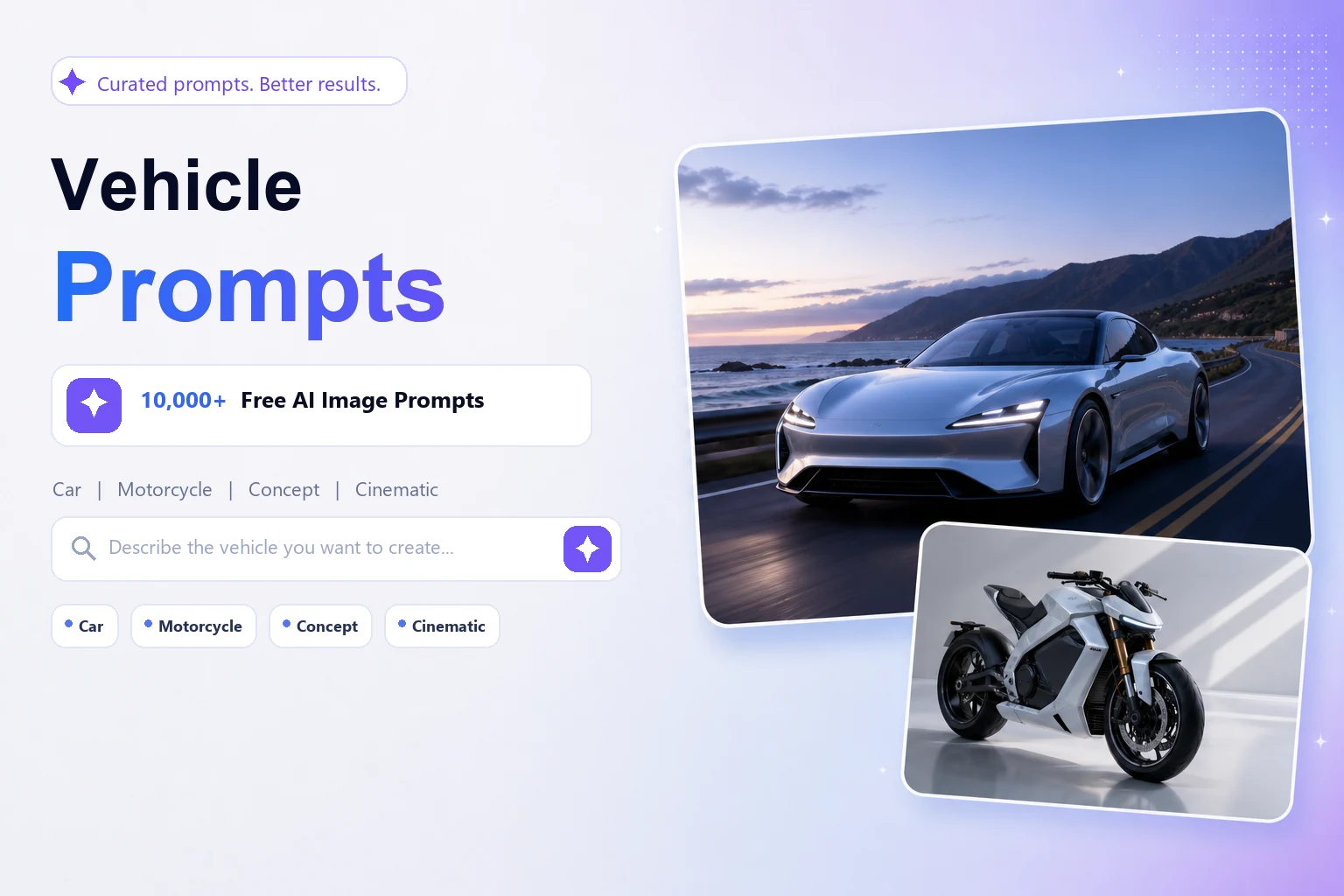
Cinematic Concept Vehicle
Vehicle
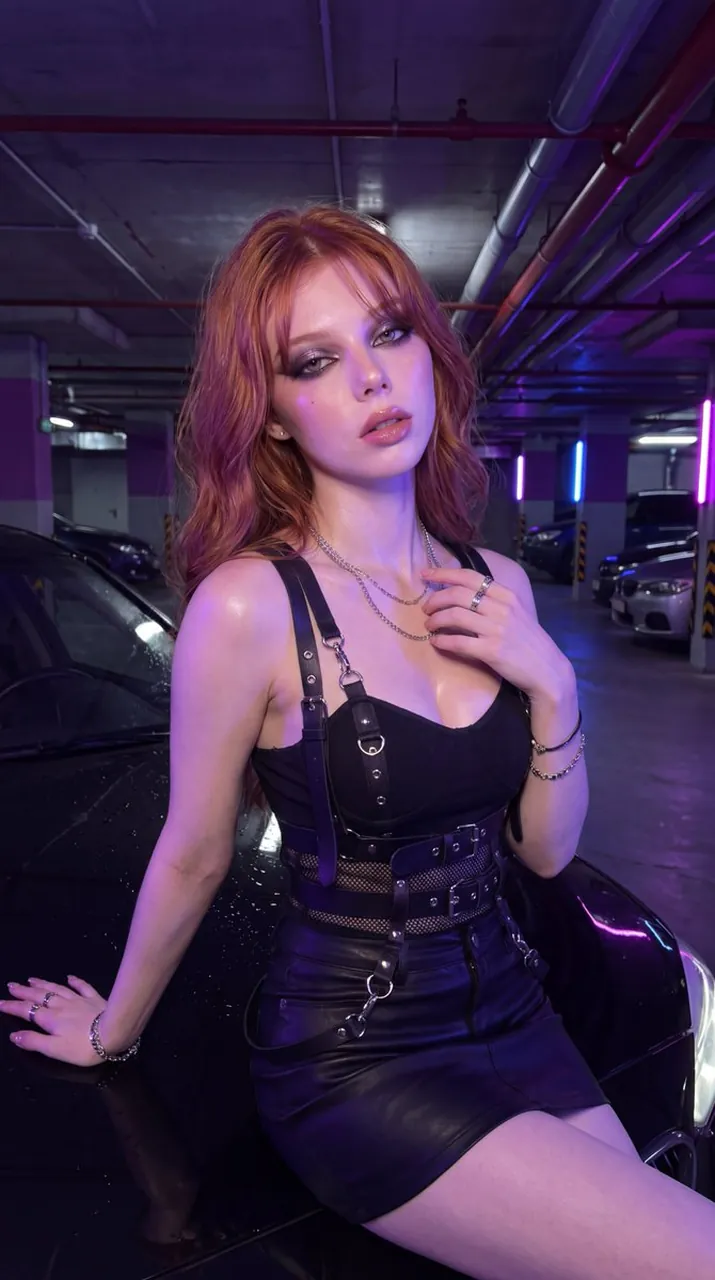
{ "prompt": "Create a hyper-realistic vertical fashion portrait of an adult woman posing inside a dark underground parking garage illuminated by vivid purple, magenta, and electric-blue neon lights. She has long, voluminous copper-red hair styled in loose, slightly tousled waves with a deep side part. She stands close to a rough concrete pillar, facing the camera with an intense, confident expression and direct eye contact. One arm is raised above her head with her hand resting naturally in her hair, while her other arm crosses softly over her lower waist. She wears a fitted black faux-leather bustier crop top with structured cups, visible seam detailing, narrow adjustable straps, and small silver hardware, paired with low-rise black bottoms visible at the bottom of the frame. Add layered silver chain necklaces with small crystal and medallion pendants, delicate silver bracelets on both wrists, a slim ring, tiny stud earrings, and glossy nude almond-shaped nails. Her makeup is dramatic cybergoth soft glam: sharply sculpted black winged eyeliner, smoky charcoal eyeshadow extended toward the temples, shimmering silver-lilac pigment across the eyelids and inner corners, softly smoked lower lash lines, defined lashes, groomed arched brows, luminous rosy blush, subtle contour, pearlescent highlighter on the nose and cheekbones, and glossy pale nude-pink lips. Preserve realistic fair skin with visible pores, subtle freckles, natural texture, fine facial hairs, and slight imperfections—no plastic smoothing. Frame her from the top of her head to below the waist in a close, straight-on portrait with a slight wide-angle smartphone perspective. The background should feature exposed industrial pipes across the ceiling, concrete beams and columns, blurred parked vehicles, and narrow vertical neon tubes creating blue and pink highlights. Use bright direct smartphone flash mixed with saturated ambient neon lighting, crisp facial detail, glossy reflections on the leather, gentle background blur, rich purple color grading, realistic shadows, subtle sensor grain, sharp iPhone-style clarity, photorealistic UGC fashion photography, 9:16 aspect ratio, 1080p HD.", "negative_prompt": "minor, childlike features, cartoon, anime, illustration, CGI, waxy skin, plastic skin, excessive airbrushing, blurry face, low resolution, flat lighting, cinematic movie still, distorted anatomy, malformed hands, extra fingers, fused fingers, missing fingers, extra arms, duplicate jewelry, crossed eyes, asymmetrical eyes, warped clothing, incorrect reflections, text, watermark, logo", "aspect_ratio": "9:16", "resolution": "1080x1920", "style": "hyper-realistic neon cybergoth fashion portrait", "camera": { "device_style": "iPhone 15 Pro main camera", "angle": "straight-on at eye level", "framing": "close vertical portrait from head to below the waist", "focus": "razor-sharp face and makeup with a softly blurred garage background", "lighting": "direct smartphone flash mixed with purple, magenta, and electric-blue neon" } }
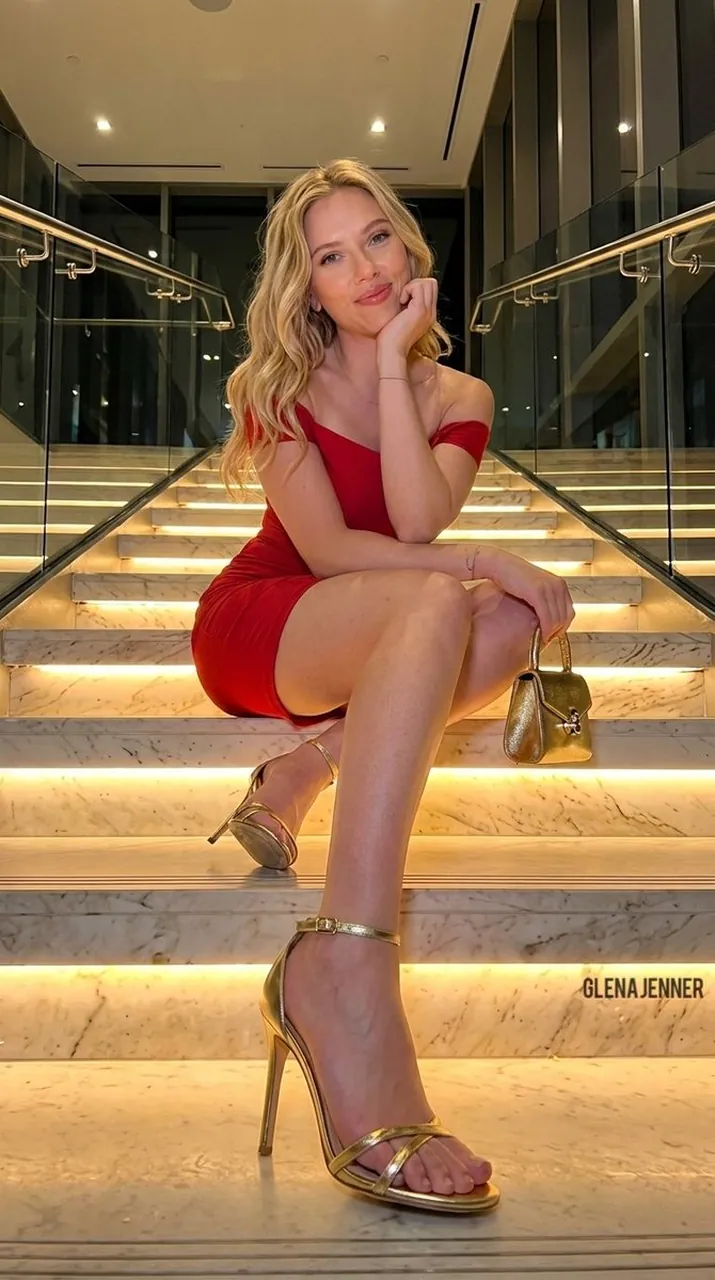
{ "description": "Young woman seated on an illuminated luxury staircase, high fashion photography style", "identity_lock": "strict, preserve exact facial features, eyes, lips, nose, jawline, bone structure, skin tone, and overall identity", "pose": "sitting on staircase with one leg extended toward the camera creating strong perspective distortion, other leg bent closer to body, torso angled slightly sideways, one arm resting casually on knee while holding a small metallic handbag, shoulders relaxed", "expression": "playful wink with lips pursed in a kiss expression", "body": "natural proportions, elegant posture, elongated legs emphasized by camera perspective", "hands": "one hand resting naturally on knee while holding handbag, other arm relaxed against body" }
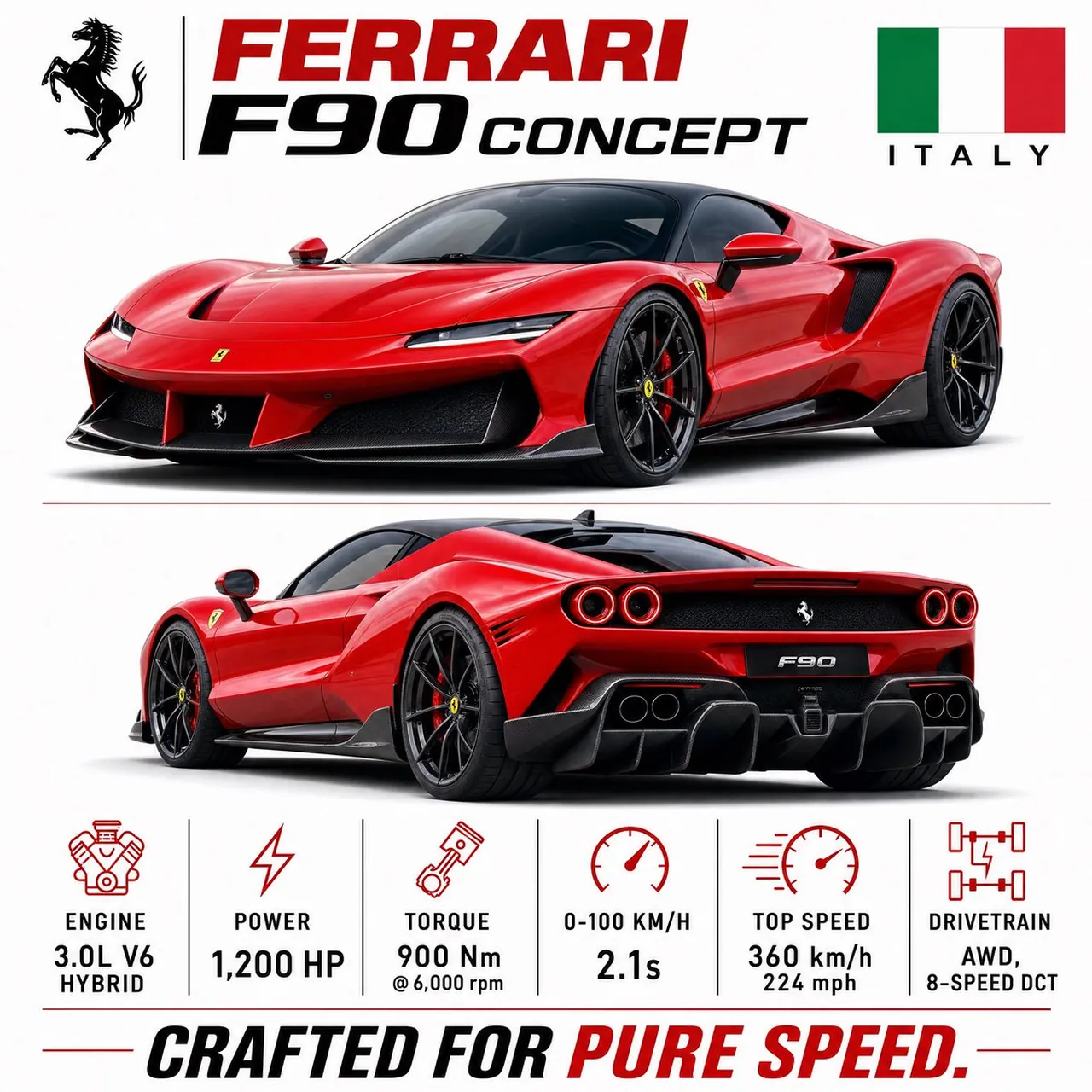
"Automotive concept poster, white background, top banner with Ferrari prancing horse logo and 'FERRARI F90 CONCEPT' in bold red/black text, Italian flag + 'ITALY' subtitle. Front 3/4 shot of a sleek red hypercar with aggressive front splitter and matte black wheels. Spec icon row: Engine (3.0L V6 Hybrid), Power (1,200 HP), Torque (900 Nm @ 6,000 rpm), 0-100 km/h (2.1s), Top Speed (360 km/h / 224 mph), Drivetrain (AWD, 8-Speed DCT). Below, rear 3/4 shot showing large rear diffuser and quad taillights. Bottom tagline: 'CRAFTED FOR PURE SPEED.
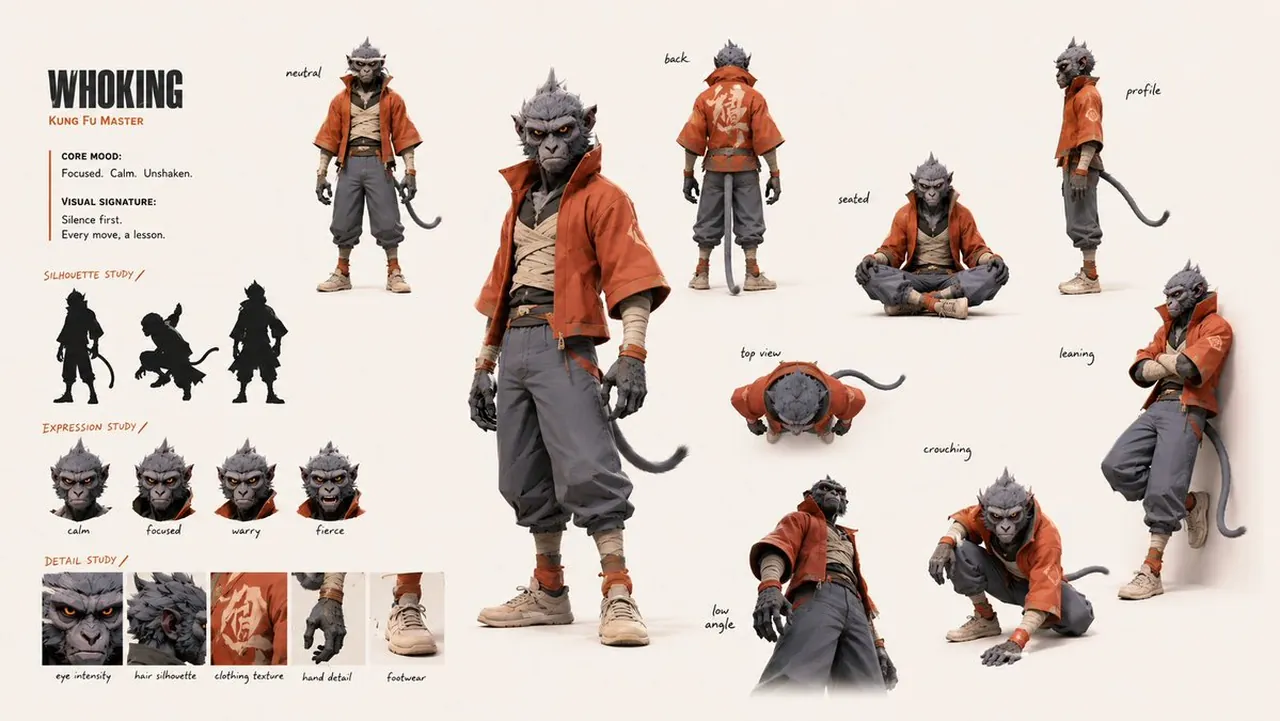
Create a 16:9 STORYBOARD SHEET image. Use the two provided reference images for character identity only. Image A is Whoking, the monkey kung fu master. Image B is Dao Wang, the serpent kung fu master.
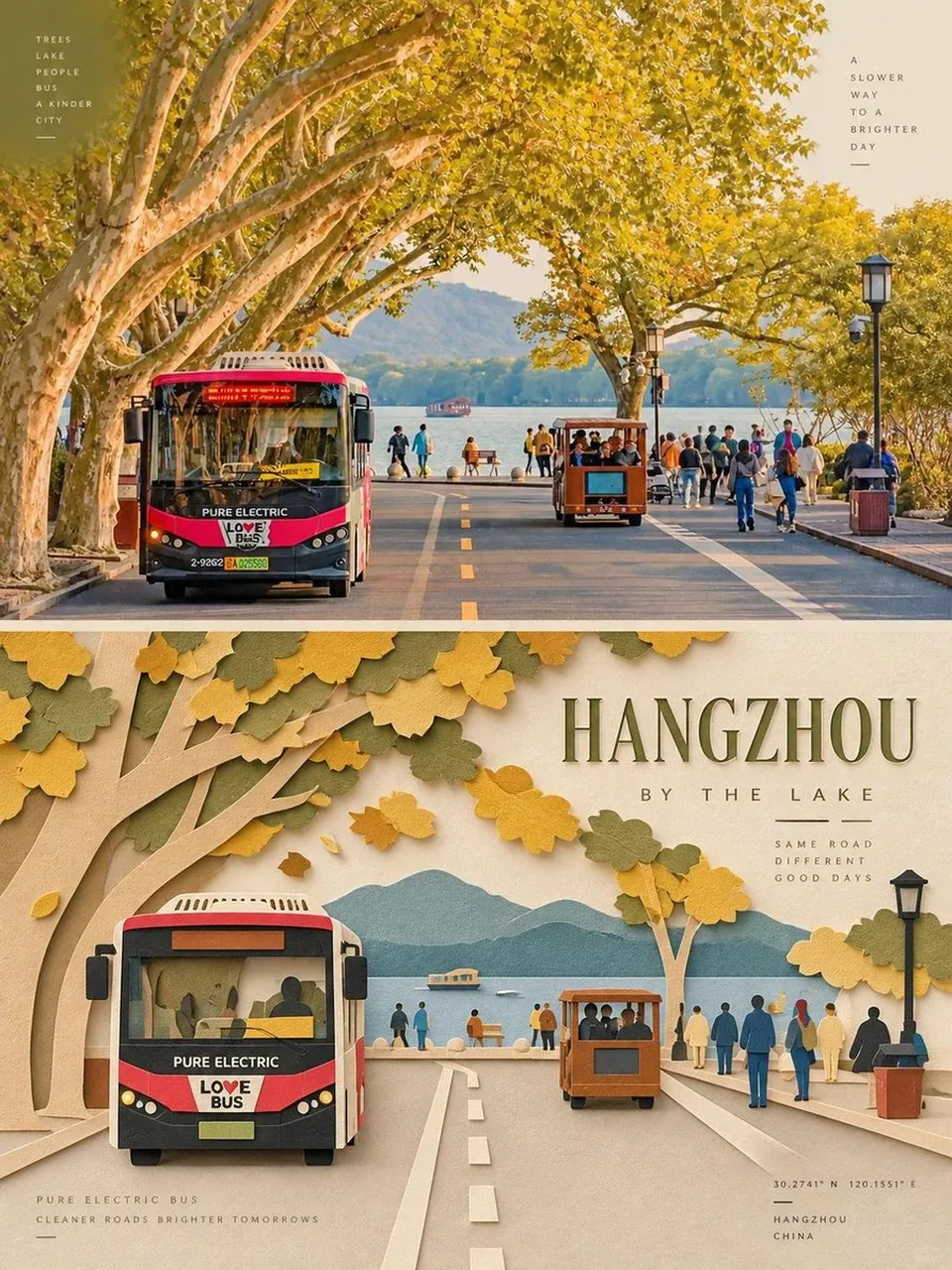
Create one independent editorial-style poster for each uploaded photo. Do not make a collage. Process and output each photo separately. Use a strict 3:4 vertical composition, divided horizontally into two exactly equal sections, each occupying 50% of the canvas. TOP HALF — ORIGINAL PHOTOGRAPH Preserve the original photo. Keep the main subject unchanged while retaining its realistic texture, natural lighting, and original color atmosphere. Apply only subtle editorial-grade color correction to create the refined feel of an art magazine, independent publication, or exhibition photography. To fit the composition, you may gently extend the sky, ground, or surrounding environmental background, but do not stretch, distort, or alter the main subject. BOTTOM HALF — LAYERED PAPER CUT / PAPER ART REINTERPRETATION Reinterpret the most recognizable subject, silhouette, pose, and spatial relationships from the photo as a minimalist layered paper-cut / paper-art composition. Use one primary subject as the visual anchor. Do not mechanically reproduce every detail. Instead, reconstruct the key silhouette, proportions, and structure through folding, cutting, layering, and overlapping. Transform only a few supporting environmental elements into foreground, midground, and background paper layers. Use scale contrast, negative space, clean alignment, and front-to-back layering to make the subject immediately recognizable while maintaining a restrained editorial composition. COLOR & MATERIAL Extract the most distinctive and recognizable colors from the original photo, then reduce them into a limited and harmonious paper-art palette. Use warm ivory or light-colored paper as the base, supported by a small amount of stronger accent colors, darker structural tones, soft transitional layer colors, and very limited highlights. The material should resemble high-quality matte cardstock, with subtle visible paper fibers, clean cut edges, and soft contact shadows under natural diffused lighting. Emphasize the tactile quality of real handcrafted paper art. Avoid glossy plastic-like 3D effects, cheap craft-paper aesthetics, neon colors, and overly saturated or complex gradients. EDITORIAL TYPOGRAPHY SYSTEM Add a refined editorial typography system. Based on the identity, location, action, material, emotion, or symbolic meaning of the subject, create one short main title. Add 2–4 groups of smaller supporting text. These may include object names, location information, numbers, sequence markers, coordinate-like numbers, direction words, status words, material descriptions, classification labels, or a very short poetic phrase. Do not use any year or date. The main title should convey emotion and identity, while the smaller text should add rhythm, structure, and refinement. TYPOGRAPHY INTEGRATION Integrate the typography naturally into the composition so that it interacts with the paper-cut forms. Arrange text along paper-layer edges, subject contours, geometric axes, or areas of negative space. Use horizontal or vertical typesetting, rotated text, generous letter spacing, edge alignment, corner placement, cross-section layouts, embedded typography, or partially overlapped text. The main title may have a subtle paper-cut or folded-paper quality, while the supporting text should remain thin, modern, restrained, and precise. The final result should feel elegant, tactile, balanced, art-directed, and distinctly editorial.
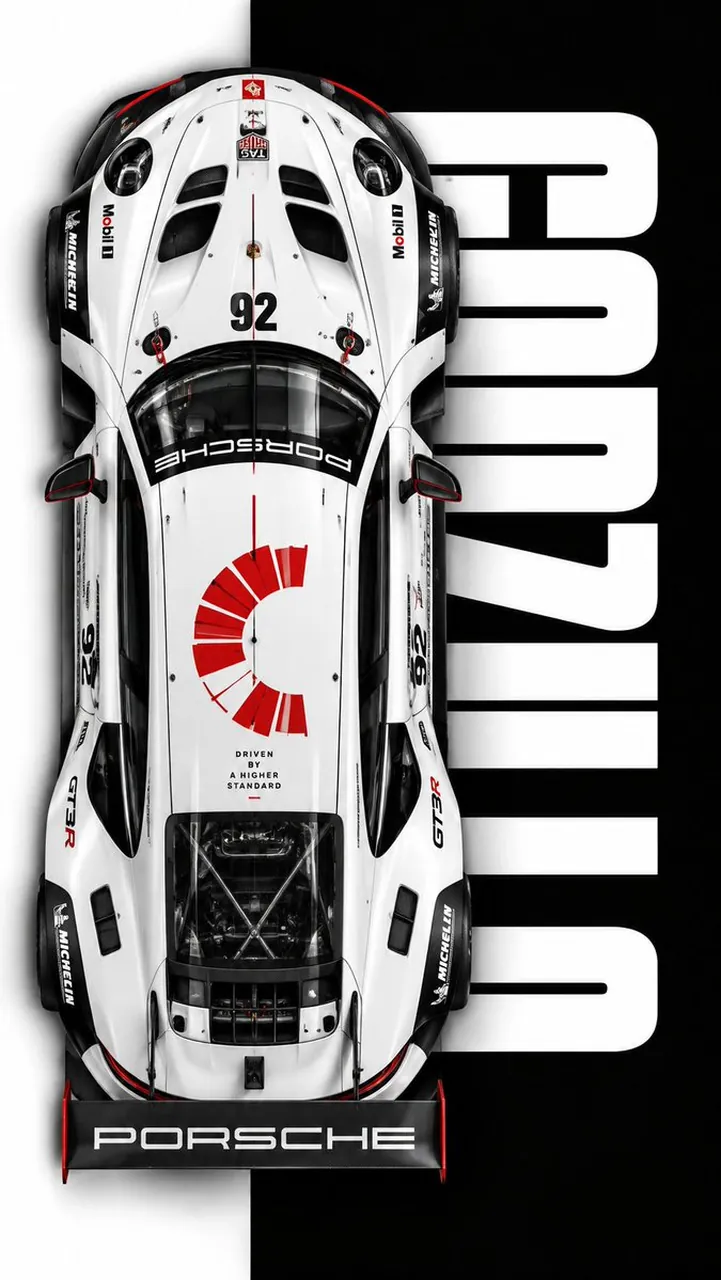
Create a hyper-realistic premium motorsport editorial poster featuring a white GT race car photographed from a dramatic high-angle top-down perspective. FORMAT: Vertical 9:16 composition, ultra-high resolution, clean commercial automotive photography, sharp details, realistic reflections and materials. MAIN SUBJECT: A white professional GT racing car viewed almost perfectly from directly above, positioned vertically along the left and center of the frame. The entire car should be visible from front to rear. The car is oriented vertically, with the front toward the top of the image and the rear toward the bottom. The vehicle has an aggressive wide-body racing design with: - White aerodynamic bodywork - Black aerodynamic vents and openings - Exposed racing wheels - Large slick racing tires - Detailed metallic multi-spoke wheels - Red accent lines around the body - Large rear aerodynamic wing - Racing splitter and diffuser - Complex aerodynamic panels - Visible windshield and cockpit - Realistic panel seams, screws, vents and carbon-fiber components The car should look like a professional endurance or GT race car, with authentic motorsport proportions and extremely detailed aerodynamic bodywork. CAR DETAILS: The tires are black racing slicks with realistic white sidewall lettering. The wheels should be highly detailed metallic dark gunmetal alloy wheels with visible brake components behind the spokes. Add subtle red motorsport branding and graphics on the white bodywork. Include a large red circular abstract racing logo or graphic on the central side panel. Use small realistic sponsor-style decals and technical markings throughout the car. PERSPECTIVE: Extreme top-down automotive photography. The camera is positioned almost directly above the vehicle, creating a flat graphic composition while maintaining realistic three-dimensional depth. The car occupies approximately 65 to 70 percent of the image width and extends almost the full height of the composition. BACKGROUND: Pure minimalist black and white graphic background. The entire background is divided vertically: - Left side: clean bright white background - Right side: deep solid black background Create a sharp vertical transition between the white and black areas. Behind the car, place enormous bold white geometric typography extending vertically through the black background. The typography should be extremely large, thick, modern and condensed, functioning primarily as a graphic design element rather than normal readable text. The letters should be partially hidden behind the race car. Use oversized white block letters with rounded corners and strong geometric construction. Some letters should extend beyond the edges of the composition. The typography should create a dramatic black-and-white contrast around the vehicle. LAYOUT: The white race car sits directly over the boundary between the white and black background. The left side of the car blends visually into the white area while the right side overlaps the giant white typography on the black background. The oversized letters must remain behind the car and should never cover the vehicle. Create strong negative space around the car while maintaining the bold graphic appearance. LIGHTING: Bright studio lighting from above, producing soft realistic shadows beneath the car. Use clean high-key illumination on the white bodywork. The black background should remain deep and pure without unnecessary gradients. Add subtle realistic reflections across the glossy white paint, windshield, metallic wheels and carbon-fiber components. The vehicle should have a premium studio-rendered appearance while remaining photorealistic. MATERIALS: Extremely realistic glossy white automotive paint. Realistic carbon fiber texture. Brushed and polished metal wheels. Transparent windshield glass. Rubber racing tires with detailed texture. Small red painted accents. Sharp aerodynamic edges. GRAPHIC STYLE: Minimalist luxury motorsport advertising campaign. Combine: - Premium automotive photography - Brutalist graphic design - Motorsport editorial design - High-contrast black and white composition - Oversized geometric typography - Clean modern advertising aesthetic COLOR PALETTE: Pure white Deep black Dark charcoal Metallic gunmetal Small amounts of vivid racing red No unnecessary colors. FINAL IMAGE: Photorealistic professional automotive campaign poster, extremely detailed race car, realistic proportions, dramatic overhead perspective, crisp edges, high contrast, clean studio lighting, premium motorsport advertising, minimalist composition, bold oversized typography, sophisticated editorial art direction, ultra-detailed 8K quality. IMPORTANT: Keep the exact overall composition of the reference: vertically oriented white race car positioned across the white and black background boundary, giant white geometric letters behind the car on the black side, minimal color palette, strong top-down perspective, red racing accents, and a clean premium motorsport poster aesthetic.
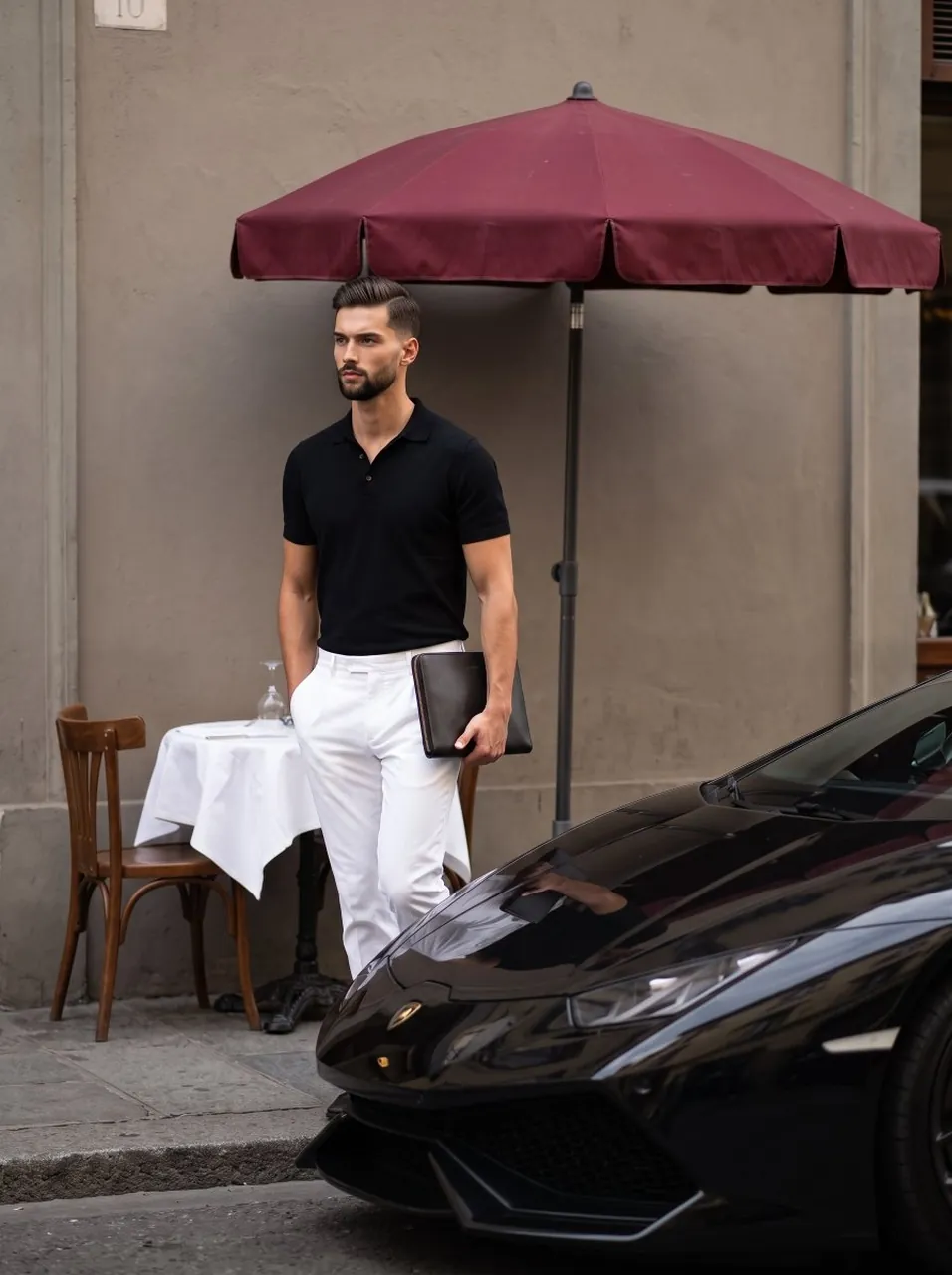
A stylish, confident man stands fully visible on the left, angled in a 45-degree turn with a relaxed, centered posture and level shoulders, dressed impeccably in a black polo shirt and crisp white trousers. He projects a posed yet effortless sophistication with a serious, unsmiling expression, relaxed eyebrows, and a gaze directed thoughtfully away from the camera, his right hand resting casually in his pants pocket with organic tension while his left hand naturally grips a dark leather folio by his side. He walks alongside the sleek hood and front wheel of a sharp black luxury sports car that heavily anchors the right foreground, creating an asymmetrical balance that draws the eye from the polished vehicle back to the walking man. Behind him, the midground opens into a medium-depth outdoor urban European sidewalk cafe featuring a covered bistro table draped in a pristine white cloth and a wooden outdoor chair. Dominating the upper background is a pristine, round burgundy market patio umbrella with a wooden pole, set against a smooth, matte warm gray plaster wall detailed with a slightly textured horizontal molding stripe and subtle utility fixtures, all grounded by a solid gray concrete floor. The blurred background actively isolates the subject under a single source of natural diffused light pouring softly from above, establishing a professional, moderately intense atmosphere with ambient fill. Short, gray-toned shadows with soft gradual edges pool neatly under the man, while subtle specular highlights catch the dark car hood and the fabric of his shoulders. The complementary color palette balances forty-five percent rich blacks and crisp off-whites against beige tones and a striking ten percent burgundy accent, maintaining a neutral temperature and moderate saturation with medium contrast. Captured as a realistic, tack-sharp digital photograph drawing heavily from luxury automotive and street style editorial photography, the image is shot from a low angle on a full-frame camera using an 85mm portrait lens at f/1.8 to achieve a shallow depth of field, finished with low film grain, subtle desaturation of background tones, and clean color grading to emphasize deep blacks, all beautifully framed in a 3:4 aspect ratio.
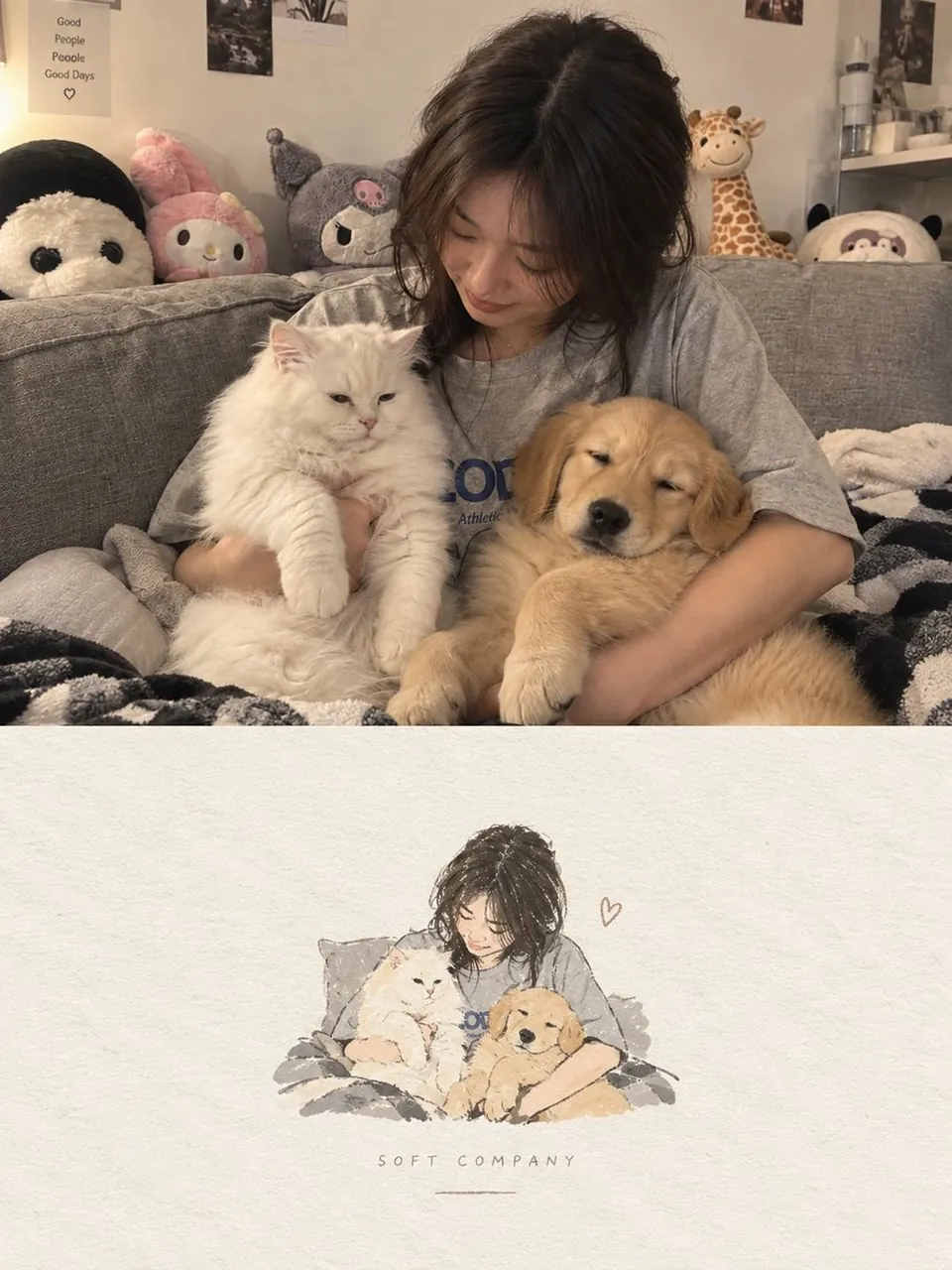
Create one independent high-end editorial poster for each uploaded photo. Do not combine multiple photos into a collage. Each photo must be processed and output as a separate poster. OVERALL FORMAT Strict 3:4 vertical composition. Divide the canvas horizontally into two exactly equal sections, with a precise 1:1 height ratio. The top half occupies exactly 50% of the canvas. The bottom half occupies exactly 50% of the canvas. The two sections should feel visually connected as one refined art publication cover. TOP HALF — ORIGINAL PHOTOGRAPH Preserve the original photograph as faithfully as possible. Keep the main composition, subjects, identity, facial features, body proportions, poses, expressions, clothing, objects, and spatial relationships unchanged. Preserve the realistic photographic texture, natural lighting, shadows, atmosphere, and original color mood. Apply only subtle, sophisticated editorial color grading, creating the feeling of a premium magazine photograph, contemporary art book, or high-end independent publication. The image should remain photorealistic and authentic, never overly retouched or artificially stylized. If necessary to fit the 3:4 composition naturally, extend the sky, ground, walls, or surrounding environmental background. Background extension must feel seamless and photographic. Never stretch, distort, reshape, replace, or alter the main subject. BOTTOM HALF — MINIMAL HAND-DRAWN PAPER ILLUSTRATION Extract the most recognizable visual elements from the original photograph and reinterpret them as a minimalist hand-drawn paper-cover illustration. Preserve: The most recognizable subject Essential silhouette and proportions Key pose or gesture Important objects The core narrative relationship between people and objects Highly simplify the image. Remove unnecessary details and retain only the visual information needed for immediate recognition. Use: Delicate, slightly imperfect hand-drawn lines A small number of bold, clearly defined acrylic-style flat color shapes Rough paper texture Visible handmade brush marks Slightly irregular, organic edges Subtle imperfections that make it feel genuinely handmade The main illustrated subject should be small, centered, and carefully composed, occupying approximately 10–20% of the bottom half. Leave a large amount of negative space around the illustration. The background should primarily resemble: Rough white paper Warm off-white paper Pale natural paper Minimal editorial book-cover stock Use only a few lines or small color shapes to suggest the surrounding environment. COLOR PALETTE Extract the dominant colors directly from the original photograph. Compress the palette into no more than 4 main colors. Keep the colors restrained, sophisticated, and harmonious. Use bold but controlled flat color blocks. Avoid excessive color variation. Preserve subtle paper grain and handmade brush texture. The illustration should visually feel like a simplified color interpretation of the photograph. TYPOGRAPHY A small amount of simple typography may be included when appropriate. Possible elements: A short title Keyword Object name Location Year Number Short phrase Text should be minimal, understated, and editorial. Typography should naturally interact with the large areas of negative space and the small illustration, evoking: Art book covers Independent publishing Contemporary editorial design Thoughtful children's picture books Do not force text into the composition if it does not naturally fit the photograph. VISUAL LANGUAGE The final poster should feel: Quiet · Poetic · Refined · Minimal · Innocent · Relaxed · Artistic · Thoughtful · High-recognition · Premium The visual concept should be: Prioritize recognition, restraint, negative space, material texture, subtle imperfection, editorial sophistication, and artistic storytelling over decorative complexity.
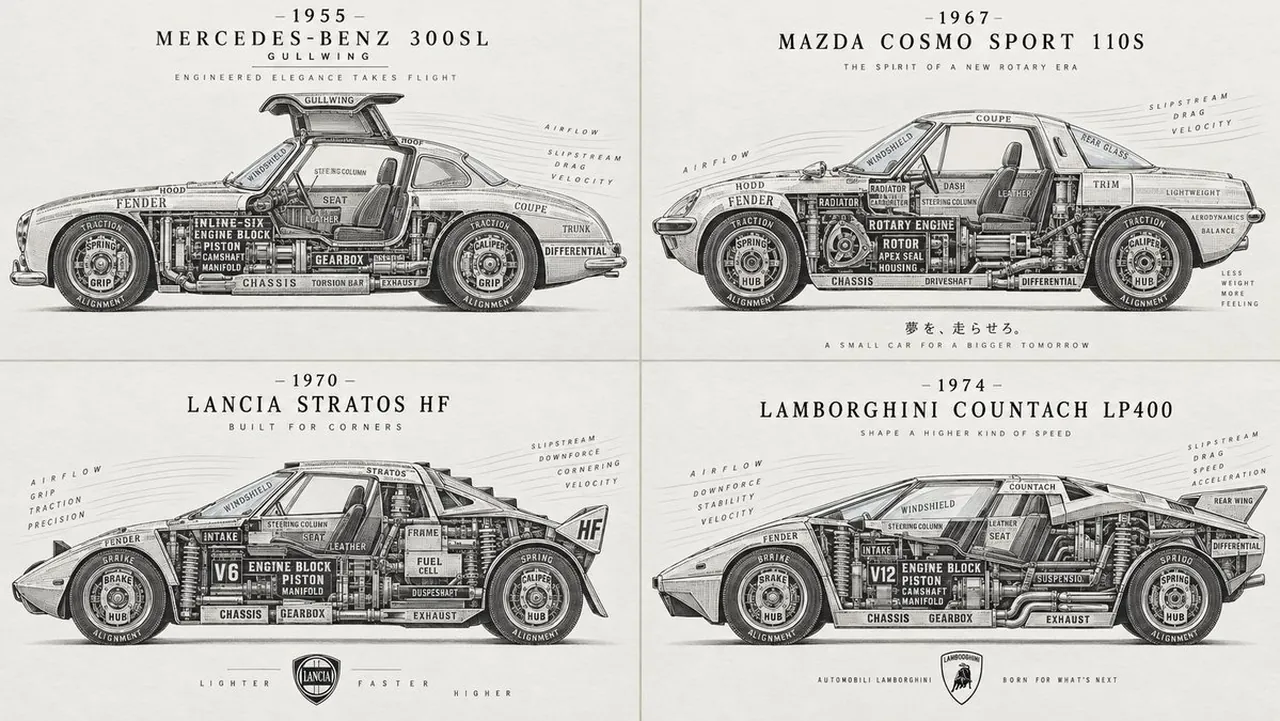
A different kind of car infographic. Works even better with GPT Image 2.5 2x2 grid, 16:9, do this for 4 unusual but real classic cars: Create one image of a world famous classic sports car in side cutaway view. Variable: $ car_scene = A technical automotive cutaway where the entire vehicle is reconstructed from mechanical terminology, material vocabulary, aerodynamic language, and performance descriptors placed in true structural position. Function Draw($ car_scene){ Single centered vehicle, side profile with slight cutaway exposure. No background clutter, precise negative space, poster-like authority. The silhouette must be iconic and readable at first glance. Infer chassis, frame, suspension, drivetrain, engine block, pistons, valves, intake, exhaust, wheel hub, steering column, brake assembly, upholstery, windshield, body panel. Use aerodynamic and driving terms where relevant: torque, grip, drag, speed, acceleration, cornering. MEDIUM: Precision lead type on smooth archival vellum. INK: Graphite black, gunmetal gray, soft steel undertones. IMPRESSION: Deep controlled embossing with strongest bite in chassis and engine, lighter in glass and airflow zones. STYLE: Mid-century automotive blueprint transformed into letterpress. Chassis and engine use crankshaft, piston, axle, block, manifold, gearbox, differential in heavy industrial slab-serif. Body panels and interior use fender, hood, leather, dash, seat, trim, coupe in refined serif. Glass, airflow, and motion zones use windshield, glare, slipstream, drag, velocity in airy technical sans-serif. Wheel and suspension regions use hub, spoke, caliper, spring, traction, alignment in circular micro-type. The result should feel engineered, fast, and luxurious. Output: one image }
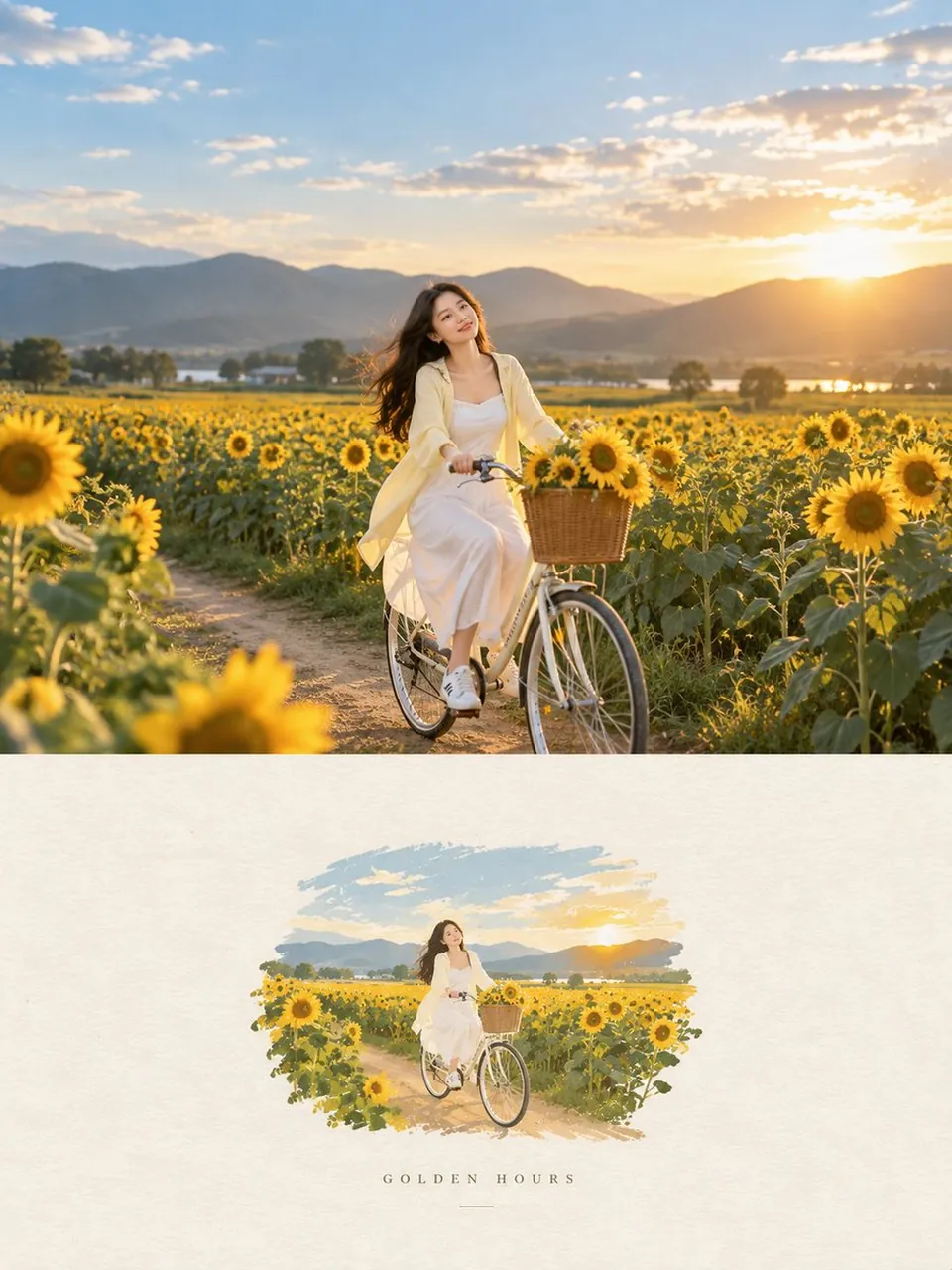
Create a high-end independent art-book editorial poster using the uploaded photo as the EXACT visual reference. STRICT FORMAT: - Vertical 3:4 canvas - Divide the composition horizontally into two equal 50/50 sections - Top half = original photograph - Bottom half = minimalist handmade-paper illustration TOP HALF — PHOTOGRAPH: Preserve the uploaded photograph faithfully and naturally. Keep the exact subject identity, facial features, pose, clothing, hairstyle, body position, objects, environment, composition, perspective, lighting and recognizable details. Do not redesign or replace the subject. Do not change the scene. Apply only subtle premium editorial color grading with soft natural contrast, refined tones and realistic photographic texture. The photograph should remain photographic and occupy exactly the entire top 50%. BOTTOM HALF — MINIMALIST ILLUSTRATION: Reinterpret only the most recognizable elements from the original photo as a small centered handmade paper illustration. The illustration must: - occupy only around 10–20% of the bottom section - remain clearly recognizable from the original photo - use delicate imperfect hand-drawn lines - use bold flat acrylic-like color shapes - have subtle handmade paper grain - have slightly organic imperfect edges - feel handcrafted rather than digitally perfect - use no more than 4 colors extracted from the original photograph - maintain generous warm off-white negative space around the illustration Keep the illustration small and understated. Do not let it dominate the bottom half. EDITORIAL DESIGN: Create a quiet, poetic, refined independent art-book aesthetic. Use a warm off-white paper background in the bottom half. Optional: add extremely minimal editorial typography beneath the illustration using small elegant uppercase serif lettering with generous letter spacing. Typography must be subtle and secondary. VISUAL MOOD: quiet poetic minimal refined artistic premium museum-catalogue / independent art-book aesthetic natural timeless STRICTLY AVOID: cartoon style anime watercolor colored-pencil rendering 3D rendering glossy effects photorealistic illustration busy composition large illustration commercial advertising aesthetic oversaturated colors heavy shadows excessive typography extra objects altered identity changed clothing changed pose changed facial features The final image should look like a carefully designed contemporary art-book cover where the original photograph and its tiny handmade interpretation coexist in a restrained 50/50 editorial composition.
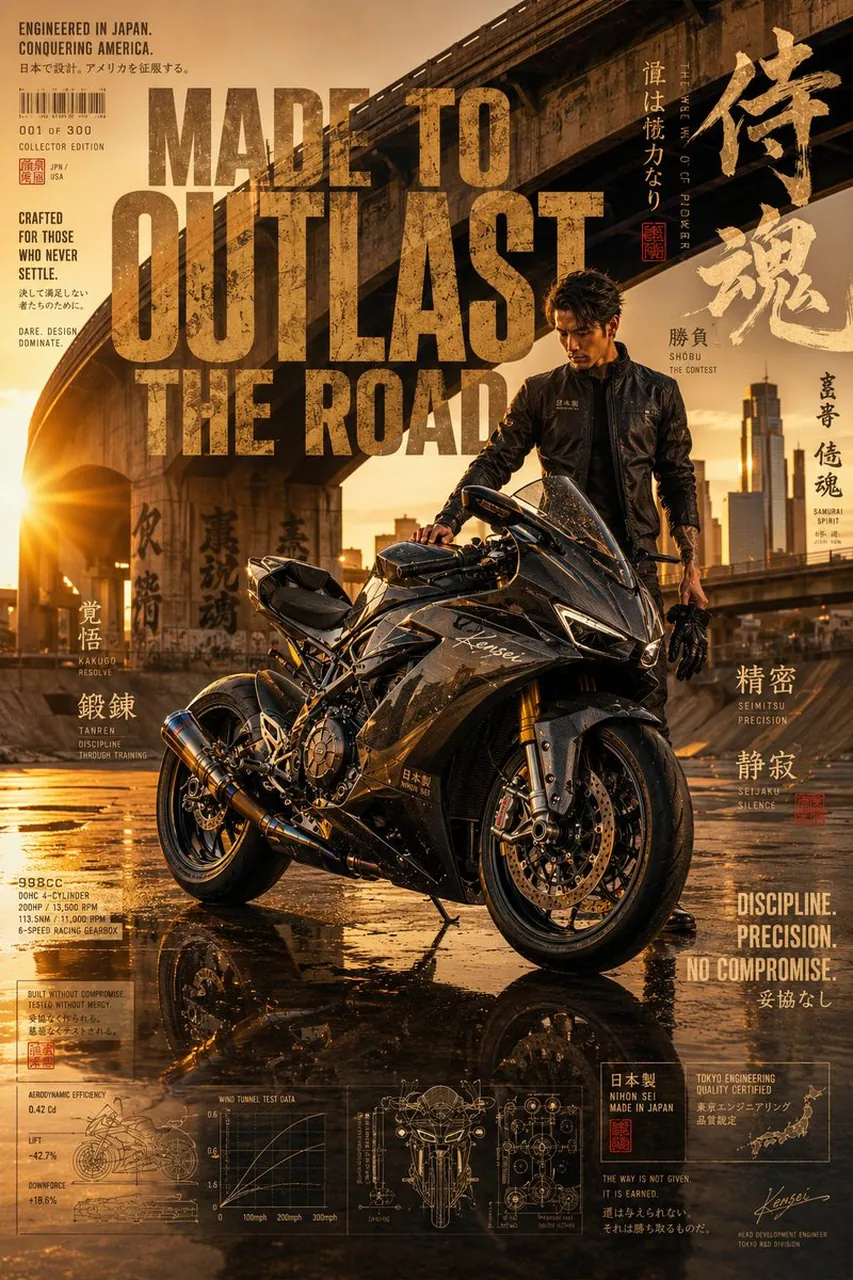
🏿 Create an ultra-premium global motorcycle campaign titled: THE WAY OF POWER This is not a conventional motorcycle advertisement. It should feel like a collector's edition fashion editorial, luxury automotive campaign, Japanese design exhibition, and modern samurai manifesto merged into one iconic image. Every detail should communicate timeless craftsmanship, restraint, precision, and engineering obsession. --- SCENE The composition is set during golden hour beneath the massive freeway overpasses of downtown Los Angeles. The sun sits low on the horizon, flooding the concrete architecture with rich amber light. Long shadows stretch across rain-soaked asphalt while the last puddles from a recent shower reflect the motorcycle like polished bronze mirrors. The concrete bridges glow with warm sunlight while distant glass skyscrapers shimmer softly against a clear sky. The atmosphere feels calm after movement—not busy, but alive. Small pockets of steam rise from drainage grates. The wet pavement reflects warm sunlight, freeway columns, and the motorcycle with museum-quality realism. --- THE MOTORCYCLE At the center stands an original Japanese-inspired superbike—not a replica of any existing manufacturer. It should embody the philosophy of Japanese engineering: razor-sharp aerodynamic bodywork exposed titanium hardware forged aluminum frame visible carbon fiber weave CNC-machined rearsets sculpted swingarm premium Öhlins-style suspension precision brake calipers titanium exhaust subtle aerodynamic winglets intricate radiator fins perfectly tensioned chain realistic bolts, welds, fasteners and mechanical components Every surface should contain tiny rain droplets illuminated by the warm sunset. The motorcycle is angled slightly toward the viewer in a heroic three-quarter perspective. The LED headlights remain on, creating a cool white contrast against the warm environment. It should feel less like transportation and more like industrial sculpture. --- THE RIDER Standing beside the motorcycle is a confident rider wearing: matte black premium riding suit minimalist tailoring subtle Japanese fashion influence no oversized racing branding premium leather gloves modern riding boots The rider removes one glove while the opposite hand gently rests on the fuel tank. Expression: calm focused disciplined earned confidence No aggressive stance. No exaggerated posing. The motorcycle should appear to be an extension of the rider rather than something they own. --- ENVIRONMENT Blend Los Angeles infrastructure with subtle Japanese philosophy. Include: towering freeway pillars industrial steel graffiti walls weathered concrete reflective puddles golden sunlight soft atmospheric haze distant downtown skyline Warm sunbeams pass between the overpasses creating cinematic shafts of light. Japanese philosophy quietly emerges through graphic design. Subtle sumi ink textures dissolve into drifting mist. Engineering sketches fade into the air. Brush calligraphy appears naturally integrated into walls and atmosphere. Nothing should feel pasted on. Everything should feel physically present. --- TYPOGRAPHY Typography is an architectural element. Not an overlay. Massive distressed condensed typography is integrated behind the motorcycle, partially hidden by architecture, reflections and light. Hero headline: MADE TO OUTLAST THE ROAD. Secondary typography: DISCIPLINE. PRECISION. NO COMPROMISE. CRAFTED FOR THOSE WHO NEVER SETTLE. ENGINEERED IN JAPAN. CONQUERING AMERICA. Typography materials: weathered paint aged steel distressed ink industrial wear subtle embossing soft transparency sun-faded textures warm metallic reflections Letters interact naturally with sunlight, architecture and reflections. ---
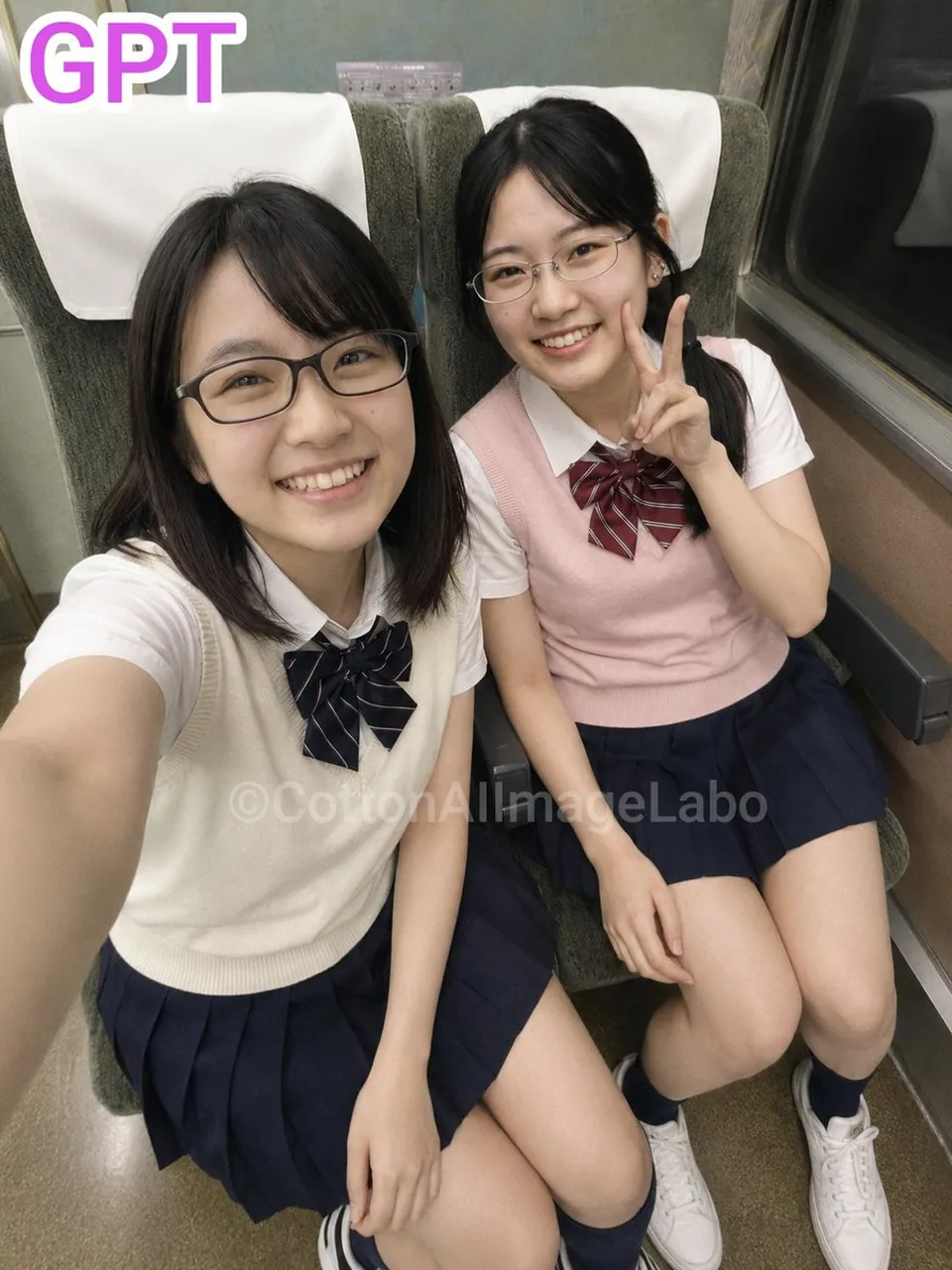
Create a realistic vertical smartphone selfie photo inside a Japanese limited express train carriage. Two cheerful Japanese high school girls sit side by side in green-gray upholstered train seats with white antimacassar headrest covers, viewed from a high wide-angle front-facing camera held by the girl on the left so her extended arm is visible in the lower left foreground. Both girls have straight black hair, youthful faces, natural skin texture, and rectangular eyeglasses, smiling warmly at the camera. The left girl has shoulder-length black hair with side bangs and wears a white short-sleeve school shirt, an ivory sleeveless sweater vest, a dark navy pleated skirt, navy knee socks, white sneakers, and a dark striped ribbon bow. The right girl has longer black hair tied back with side bangs and wears a white short-sleeve school shirt, a pale pink sleeveless sweater vest, a navy pleated skirt, navy socks, white sneakers, and a red striped ribbon bow; she raises her right hand in a peace sign near her face while her left hand rests on her lap. The train interior should include two adjacent seats, armrests, a window on the right showing a dark exterior reflection, muted beige flooring, and soft overhead carriage lighting. Use a candid photorealistic style, slight wide-angle lens distortion, casual travel snapshot composition, clean details, no extra people, no anime styling, no exaggerated makeup.
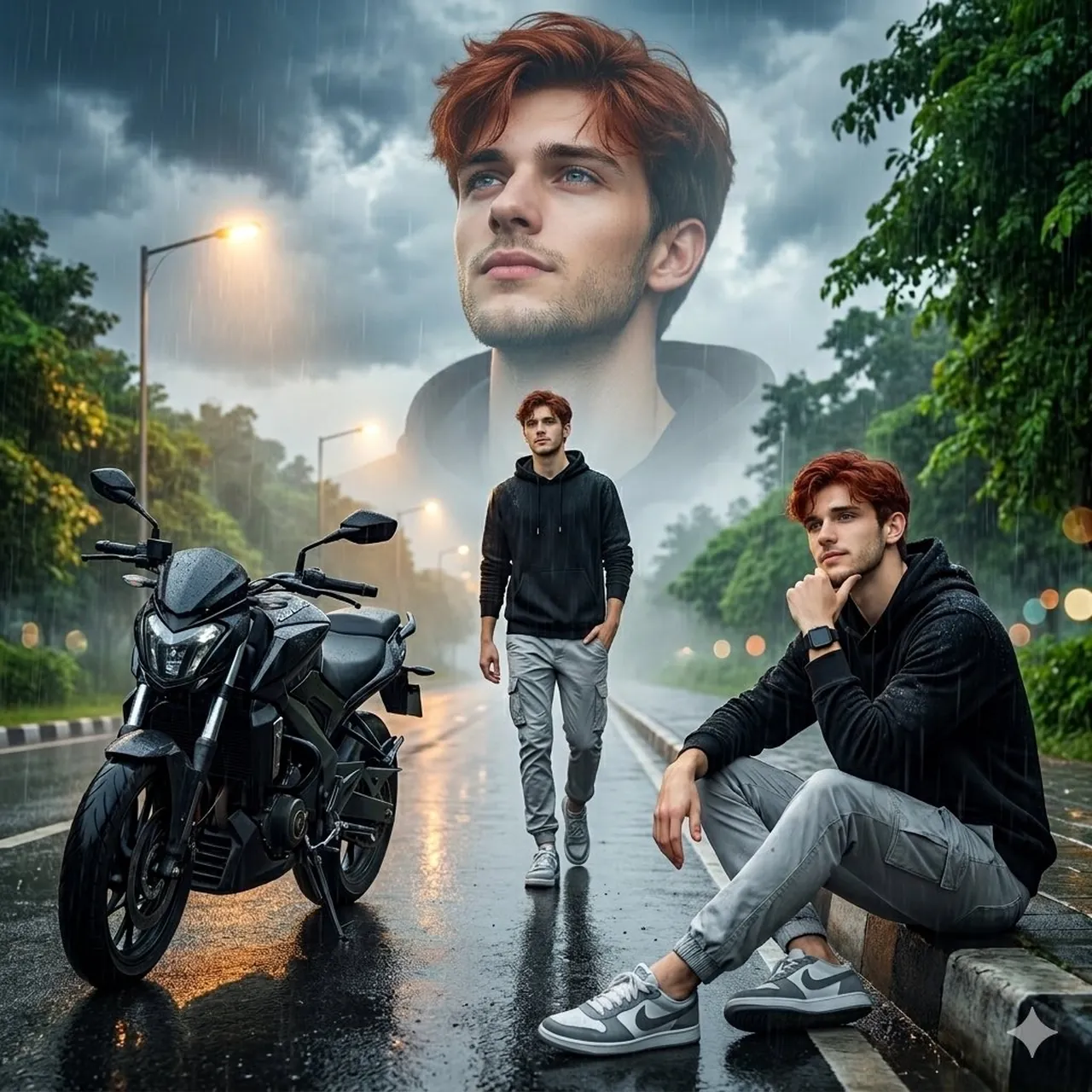
Ultra-realistic cinematic rainy-day portrait collage of a young man on an empty wet roadway during monsoon weather. The composition features three versions of the same man blended into one dramatic scene. A giant close-up portrait dominates the cloudy sky in the background, showing the man gazing upward with a calm, hopeful smile. In the foreground, the man sits casually on the curb beside a sleek black street motorcycle, resting his chin on his hand in a thoughtful pose. Another full-body version of him walks confidently down the center of the rain-soaked road with one hand in his pocket. He has short curly black hair, a neatly trimmed beard, expressive eyes, and wears a black oversized hoodie, light gray cargo pants, gray-and-white sneakers, and a black smartwatch. Raindrops are visible on his clothing and face. The environment features a deserted tree-lined avenue after rainfall, reflective asphalt, glowing streetlights, dramatic storm clouds, soft mist, wet road reflections, lush green foliage, and subtle bokeh lights in the distance. The motorcycle's headlight casts a warm glow onto the wet pavement. Professional photography, cinematic color grading, ultra-sharp focus, HDR, realistic skin texture, natural lighting, depth of field, volumetric atmosphere, moody monsoon aesthetic, emotional storytelling, highly detailed, 8K resolution, Photoshop-style photo manipulation, Instagram portrait edit, masterpiece quality.
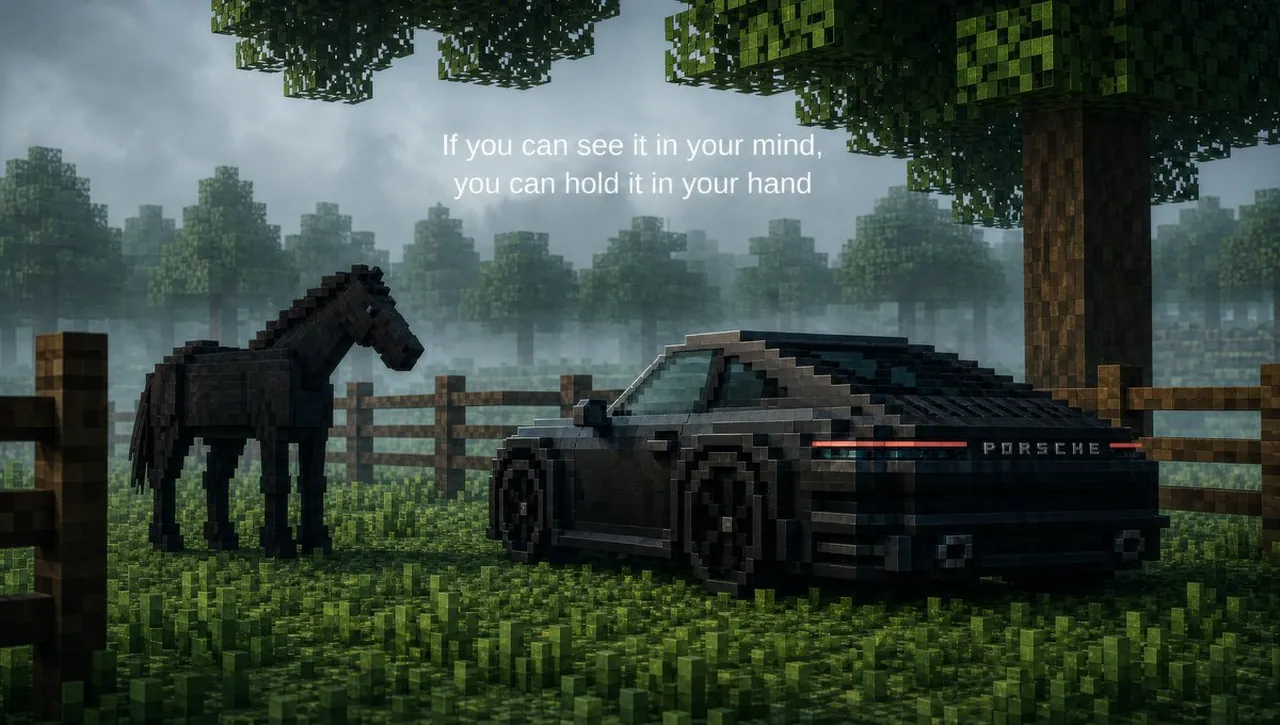
Create a cinematic 16:9 Mac desktop wallpaper in a realistic voxel-block style, like a high-end ray-traced Minecraft diorama. The scene is a misty forest pasture at dawn or dusk with moody blue-gray fog, soft volumetric light, wet grass, and a dark green color palette. In the foreground there are exactly 2 main subjects: 1 black voxel horse standing on the left in side view, and 1 low black voxel sports car on the right, rear three-quarter view, modeled like a Porsche 911 with a continuous red rear light bar and the visible rear wordmark PORSCHE. The car should look glossy, angular, and handcrafted from small blocks, with black wheels and subtle reflections. The horse should be built from dark blocks with a slightly bowed head, standing calmly near the car. Behind them is a wooden block fence running horizontally across the image, with a large blocky tree trunk on the right and leafy cubic canopy overhead, plus a foggy background forest made of many distant block trees. Add centered white inspirational text near the upper middle in exactly 2 lines: line 1 reads If you can see it in your mind, and line 2 reads you can hold it in your hand. Use a premium cinematic composition, shallow atmospheric depth, subtle rain-damp surfaces, realistic voxel lighting, no people, no extra vehicles, no logos except the car badge, and leave the image clean enough to function as a desktop wallpaper.
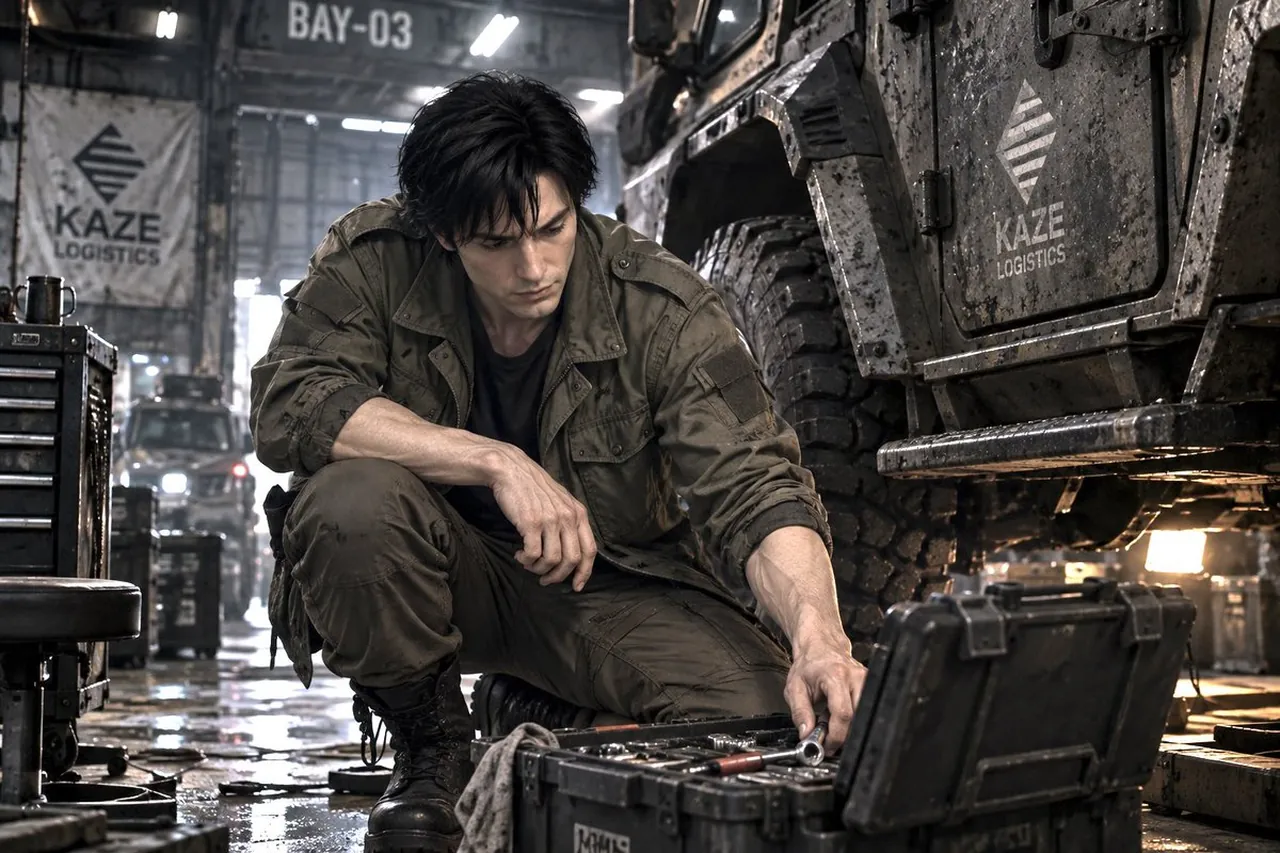
Create a cinematic photorealistic science-fiction industrial garage scene inside BAY-03. A weary young male mechanic with messy black hair, pale skin, and a serious downcast expression crouches low on the wet concrete floor beside a massive armored military-style logistics truck. He wears an olive drab field jacket over a black shirt, matching cargo pants, and black combat boots, with rolled sleeves and dirty, work-worn fabric. His left arm rests across his raised knee while his right hand reaches into an open rugged black tool case on the floor in front of him, as if selecting a socket or small tool. The truck dominates the right side of the frame, close to camera, with huge mud-caked tires, riveted dark armor panels, grime, water droplets, underbody lights, and two visible company markings reading KAZE LOGISTICS: one on the truck door panel and one on a hanging banner in the left background. Also include exactly one large overhead bay sign reading BAY-03. Around him are exactly four prominent workshop objects: an open black tool case in the foreground, a rolling black tool chest on the left, a low black mechanic stool at the far left, and a dirty rag draped near the tools. The floor is glossy with puddles and reflections, the air is hazy with dust and workshop mist, and distant vehicles and headlights blur in the background. Use a gritty near-future cyberpunk military logistics aesthetic, realistic proportions, shallow depth of field, high-detail textures, cool gray industrial lighting mixed with warm amber under-vehicle light, 35mm cinematic composition, low camera angle, no cartoon styling, no extra readable text beyond the specified labels.
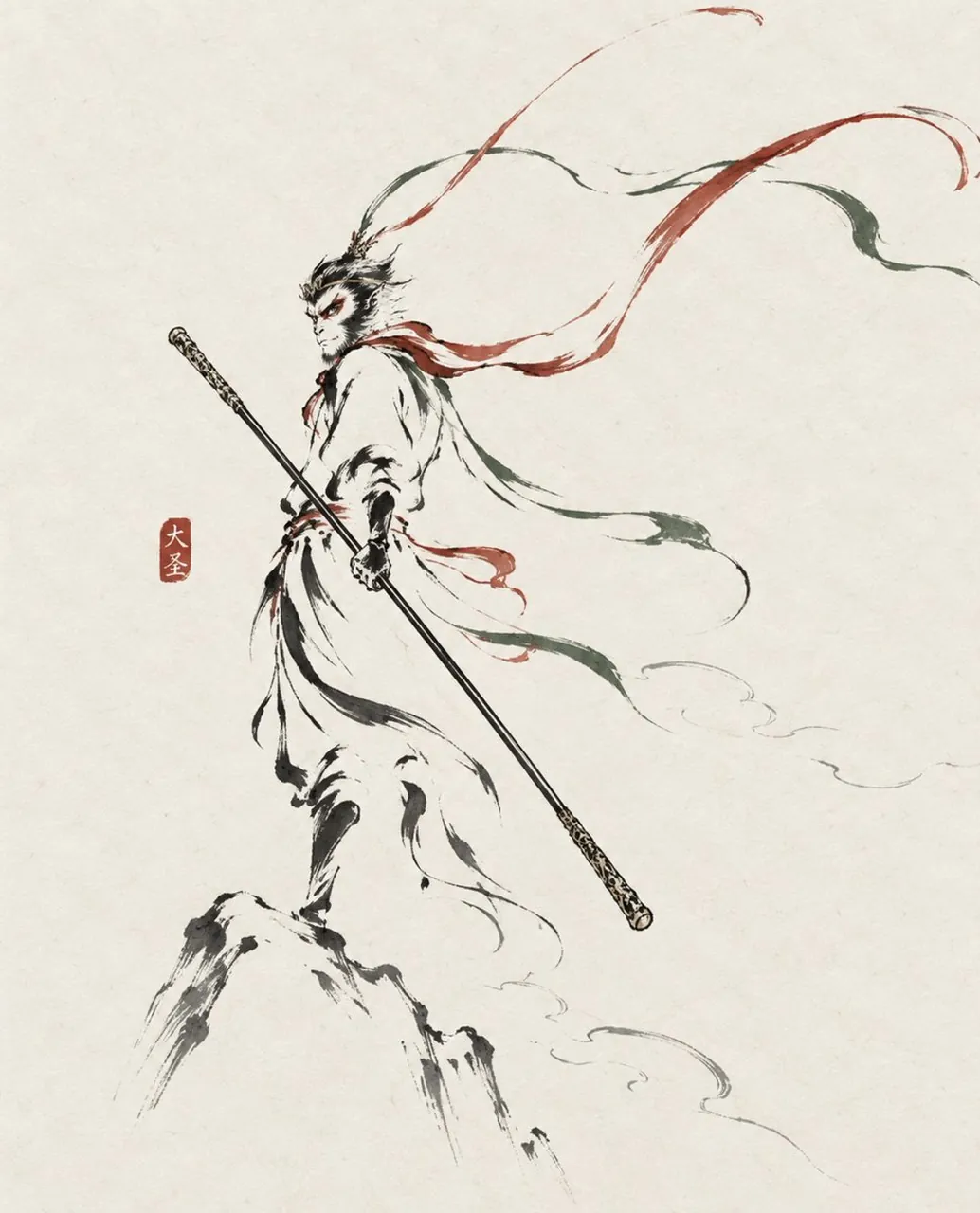
Create an Eastern ink-line character poster of Sun Wukong, the Monkey King standing heroically on a jagged mountain peak, facing left in a three-quarter profile. Use a mostly empty warm off-white rice-paper canvas with subtle fibrous texture and a minimalist Chinese brush-painting aesthetic. The figure should be recognizable but not realistic: a monkey-like face with sharp cheek lines, intense red-accented eyes, dark bristling fur around the head, and a slim athletic martial-arts silhouette. Dress the character in a loose flowing white robe with black ink folds, a red sash at the waist, and windblown ribbon streamers. He holds one long ornate staff diagonally across the body from upper left to lower right, with decorative gold-toned caps at both ends. Compose the poster with large negative space on the right and upper background; use black ink as the structural skeleton, restrained vermilion red for the scarf, eye accents, ribbons, and seal, and muted ink green for a few trailing cloth strokes and cloud-like motion lines. Add exactly one small red square seal stamp to the left of the character with the Chinese characters 大圣. Include exactly one main figure, one staff, one mountain peak, three long wind ribbons or cloth trails, several sparse cloud wisps drawn as thin broken ink lines, and no other characters. Make the brushwork expressive, dry-brush, calligraphic, asymmetrical, elegant, and dynamic, like a traditional East Asian ink wash poster with modern graphic restraint.
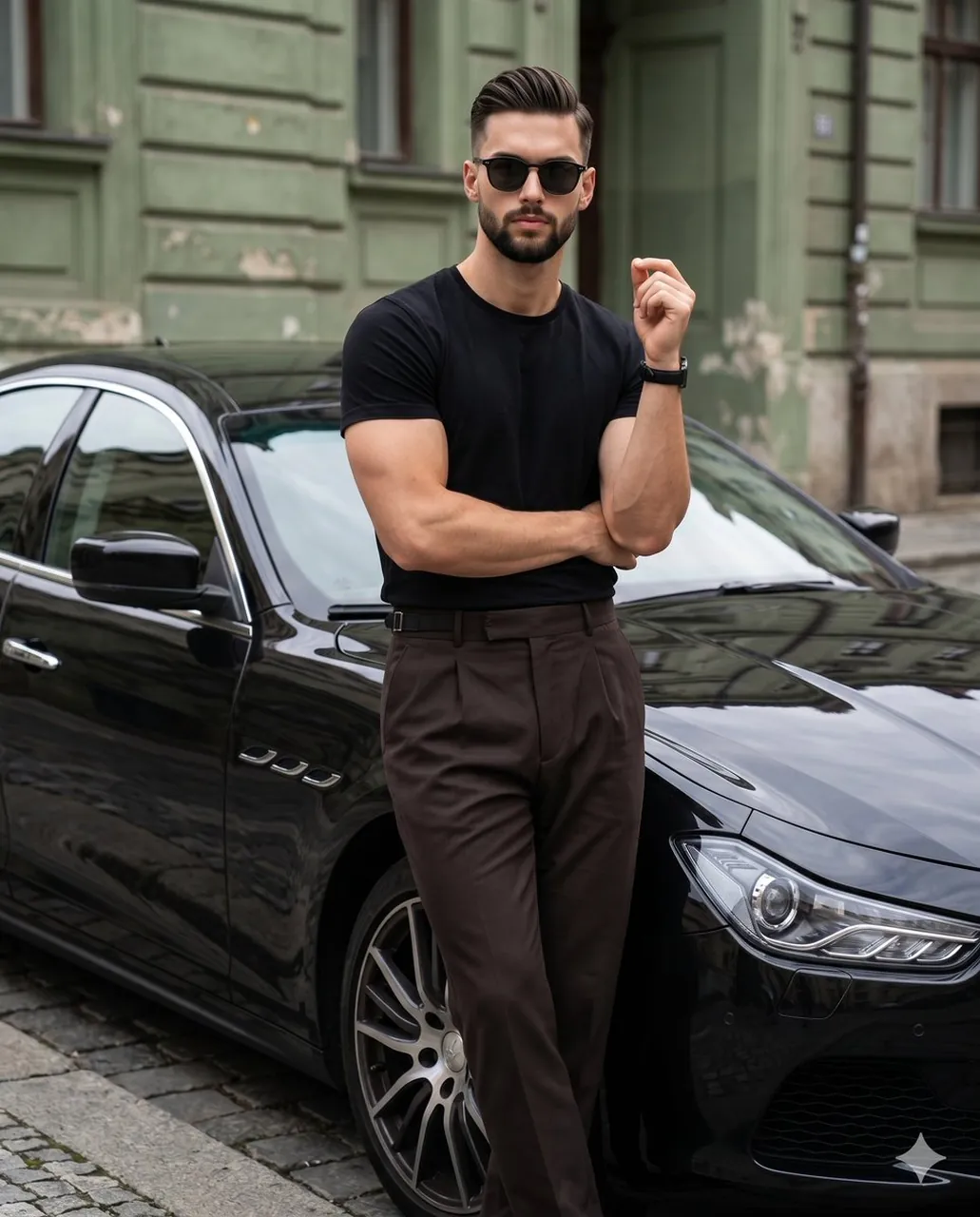
A muscular adult male with a dark taper-fade haircut pushed back with natural volume and a thick beard wears a fitted black t-shirt tucked into high-waisted, pleated dark espresso brown trousers secured by a black belt. His face projects a confident, quiet luxury, with dark sunglasses obscuring his eyes, neutral eyebrows, and a relaxed, unsmiling mouth. Facing the camera and leaning his weight slightly to the right, his right hand is folded across his lower torso and tucked firmly underneath his left bicep, while his left arm is raised to upper chest level with the wrist slightly bent outward and fingers loosely curled in a deliberate pinch-like gesture, displaying a black-banded wristwatch. He leans confidently against the front side fender of a pristine, glossy black luxury Maserati sedan occupying the left foreground, its curved chassis showcasing sleek headlights, three signature side air vents, and chrome accents on the door handles and window trim. The man and vehicle are grounded on a solid cobblestone gray concrete street, while the slightly blurred right background reveals a medium-depth view of a weathered historical building facade made of matte, slightly textured plaster painted in a uniform sage green with warm undertones, featuring sharp white window frames whose glass reflects the opposite buildings. The scene is bathed in soft, moderate-intensity natural daylight diffused from above, casting soft, gradual gray drop shadows under the car and a subtle shadow of the man against the vehicle's chassis. Gentle specular highlights gleam along the car's glossy black curves, while subtle preserved highlights accentuate the subject's forehead and arm muscles, defining an analogous, moderately saturated color palette of deep blacks, earthy browns, and sage greens. Captured straight on as a tack-sharp, grain-free digital photograph in a clean editorial style evoking an Old Money aesthetic, the image utilizes an 85mm lens at an f/2.8 to f/4.0 aperture, an ISO of 100, and a 1/250s shutter speed, finished with subtle color grading that warms the earthy tones while reducing highlights to preserve the sleek reflections, naturally framed in a 4:5 aspect ratio.
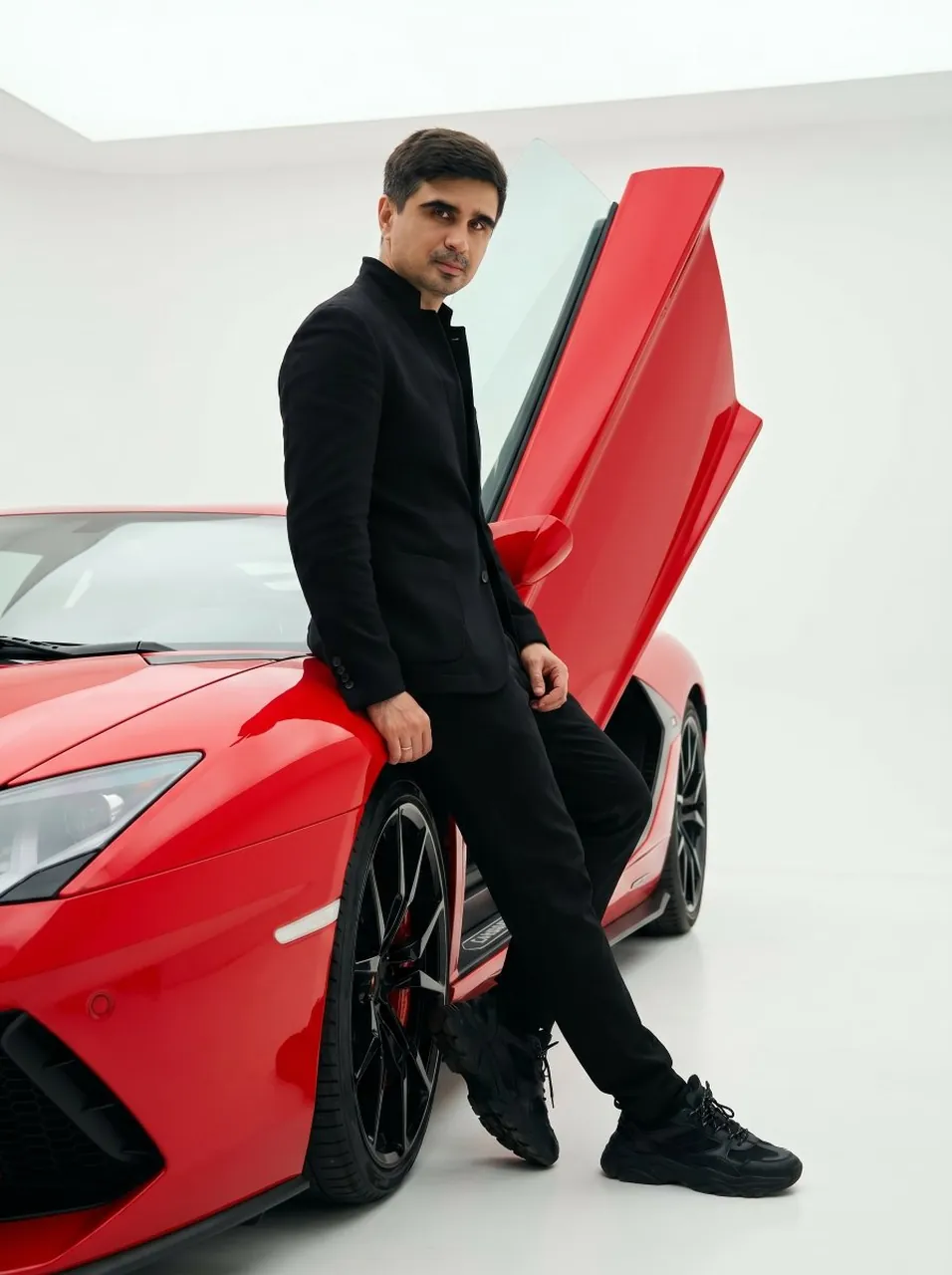
High-fashion editorial shot of a man leaning casually against the open scissor door of a red supercar. He wears a sleek all-black outfit with modern tailoring and chunky sneakers, exuding confidence and effortless dominance. Minimalist white backdrop with a futuristic luxury aesthetic. Mood: fashion prestige, automotive power, urban cool.
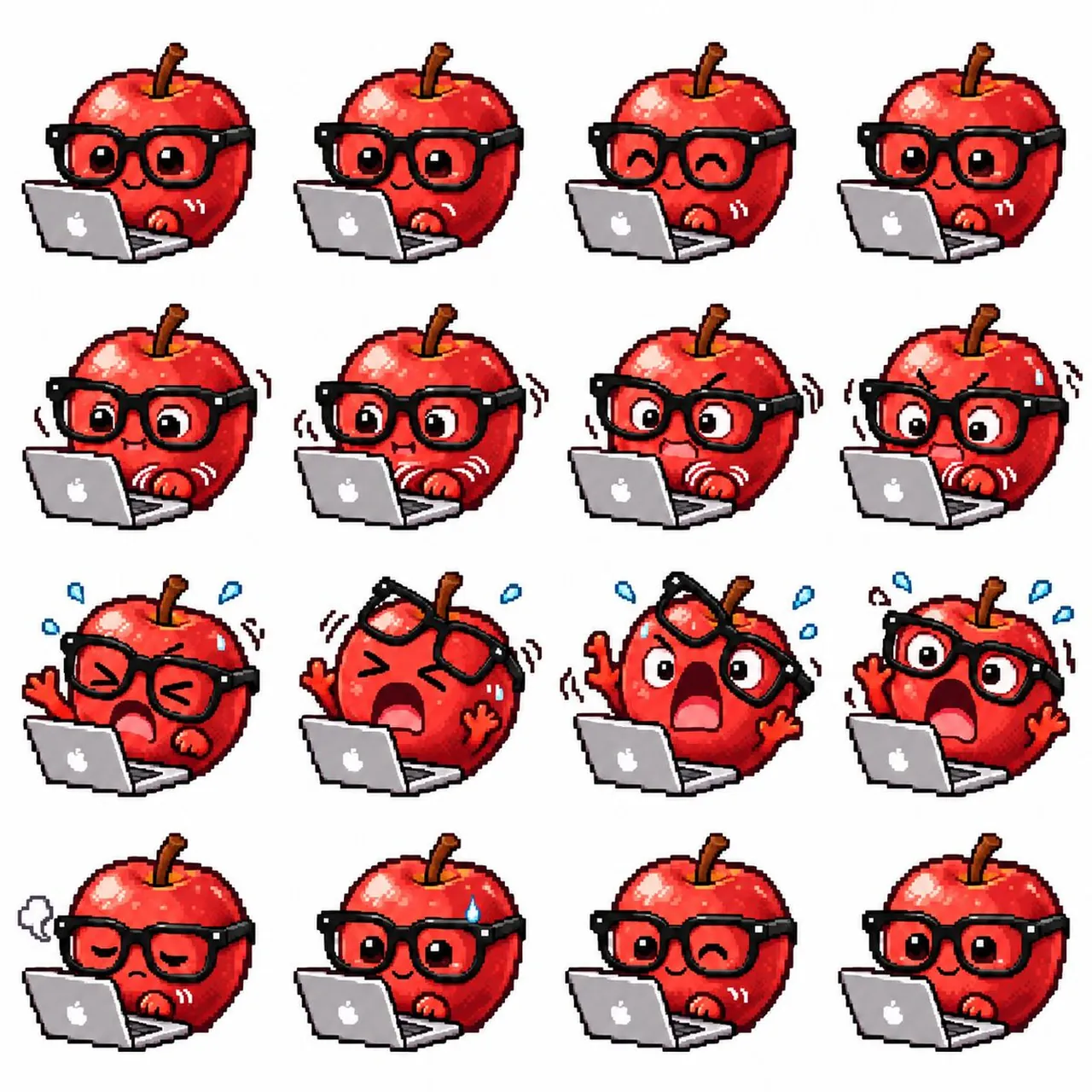
Goal: Create a cute pixel-art 4×4 sprite sheet for an animated GIF, featuring a shiny red apple mascot working at a silver laptop with a white apple-like logo. Canvas: Square white background, evenly spaced 4 columns by 4 rows, no borders or grid lines. Use crisp retro pixel art with chunky black outlines, limited-color shading, glossy highlights, and transparent-feeling clean spacing around each sprite. Subject details: The same apple mascot appears in all 16 sprites. It is a round bright red apple with glossy white highlights, a brown stem at the top, black thick-rimmed square glasses, small red hands, and a small expressive face. The laptop sits in front-left of the character in every frame, open toward the viewer, rendered in light gray and white pixel shading. Layout and exact 16-frame contents, left to right, top to bottom: 1. Calm focused apple typing, open eyes, tiny smile, one hand near keyboard, laptop in foreground. 2. Similar calm typing pose, eyes looking forward through glasses, small pleased smile. 3. Happy typing pose, eyes closed in upward arcs, smiling, relaxed. 4. Calm attentive pose, open eyes, small smile, laptop slightly covering lower face. 5. Curious or surprised focus, wide eyes looking at screen, tiny mouth, subtle motion marks near the hand. 6. Alert typing, wide eyes, both hands moving quickly, black motion lines around body and white motion lines by hands. 7. Concerned concentration, furrowed brows, wide eyes, small open mouth, shaking motion marks. 8. Stressed focus, furrowed brows, wide eyes, blush/strain on cheeks, shaking motion marks. 9. Panic while typing, eyes squeezed shut, open shouting mouth, blue sweat drops around head, one hand raised, laptop still in front. 10. Shocked panic, glasses flying upward off the face, eyes squeezed shut, huge open mouth, both arms raised, blue sweat drops. 11. Extreme alarm, one lens/glasses tilted upward, huge round eyes, enormous open mouth, both arms raised, blue sweat drops and shake marks. 12. Shocked typing panic, glasses still on, huge round eyes, open mouth, both arms raised, blue sweat drops around head. 13. Exhausted or defeated, half-closed eyes, frowning mouth, gray puff of sigh smoke on the left, one hand resting near laptop. 14. Nervous recovery, small smile with open eyes, single blue sweat drop on upper right of apple, hands near laptop. 15. Playful wink, one eye closed, one eye open, gentle smile, relaxed typing pose. 16. Return to normal happy typing, open eyes and small smile, relaxed hands near laptop. Visual style: High-resolution pixel art sprite sheet, cute mascot emoji/sticker style, saturated reds, dark maroon shadows, bright white specular highlights, black glasses with small white highlights, expressive cartoon motion lines. Keep every sprite consistent in size and centered within its cell. Constraints: Use exactly 16 sprites in a 4×4 arrangement. Do not add text, labels, captions, watermark, frame numbers, or background scenery. Keep the background plain white and preserve consistent character design across all frames.
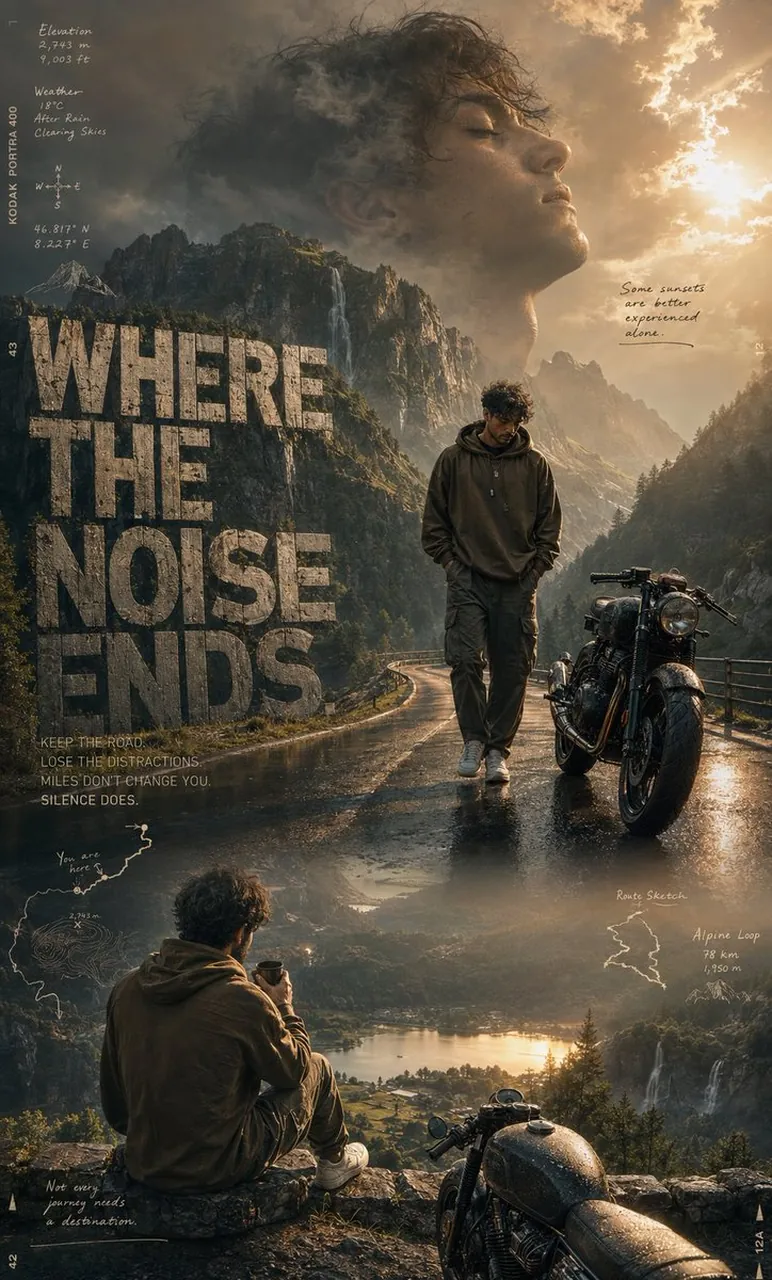
CREATE AN ULTRA-PREMIUM CINEMATIC LIFESTYLE CAMPAIGN TITLED: WHERE THE NOISE ENDS. The setting is an untouched alpine valley during the final moments of golden hour after a summer rainstorm. Warm sunlight breaks through retreating storm clouds, illuminating emerald forests, mist-covered cliffs, winding mountain roads, reflective lakes, and distant waterfalls. The central subject walks alone along a rain-soaked mountain road wearing a premium earth-toned hoodie, relaxed cargo trousers, white sneakers, and minimal silver accessories. A modern café racer motorcycle rests nearby, covered with tiny rain droplets reflecting the sunset. In the upper portion, a massive semi-transparent profile portrait emerges naturally from drifting clouds and mountain mist. The lower foreground shows the same person sitting on a weathered stone overlook above the valley, watching the golden light reflect across the lake while holding a warm cup of coffee. Typography is integrated organically into the landscape using elegant Swiss editorial design, with the text WHERE THE NOISE ENDS carved into the mountainside. Include supporting editorial copy, handwritten field notes, travel journal annotations, elevation markers, and minimal technical graphics. The color palette features warm golden sunlight, soft amber, forest green, deep olive, stone gray, natural black, cream, sky blue, muted teal, and earth brown. Lighting includes glowing golden-hour sunlight, warm volumetric rays, wet asphalt reflections, soft rim lighting, realistic water droplets, rich atmospheric depth, and cinematic lens bloom, 8K masterpiece.
Choose a vehicle prompt and copy the full text.
Adjust the vehicle type, design, color, environment, camera angle, and visual style to match your concept.
Paste the prompt into the image generator, choose a model, and create your vehicle image.
Follow these steps to turn a vehicle prompt into a distinctive AI image.
Browse by type
Browse image, video, or the complete prompt library.
Design the next ride
Choose a vehicle prompt, customize the design and setting, and generate an original automotive concept in seconds.