
Seedance 2.0 vs HappyHorse 1.0: Which Fits Real Video Work?
- Quick comparison before we go deeper
- Same-prompt test videos
- The leaderboard says HappyHorse is hotter. It does not settle the whole decision.
- HappyHorse 1.0 wins attention because it feels closer to finished video
- Seedance 2.0 looks stronger once control starts to matter
- The real gap shows up after the first good-looking clip
- Dialogue scenes and short directed beats reveal more than silent beauty shots
- Which one should you choose?
- FAQ
- Final take
Most comparisons stop too early.
They look at the first attractive clip, point to a leaderboard, and call the match. That is not useless, but it is incomplete. The more practical question is what happens after the first nice-looking result: when you need a second pass, a tighter performance, cleaner lip sync, steadier continuity, or a reference-led revision that does not break the whole shot. That is where this comparison gets more useful.
My read is simple. HappyHorse 1.0 currently has the hotter public momentum. Seedance 2.0 makes more sense when the job is not just to generate a clip, but to keep control as the clip turns into a workflow. That does not make one model universally better. It means they start to separate once you care about revisions, dialogue timing, reference input, or multi-shot consistency under pressure.
Quick comparison before we go deeper
| Decision lens | HappyHorse 1.0 | Seedance 2.0 |
|---|---|---|
| Public momentum right now | Stronger overall leaderboard momentum | Still near the top, especially strong in image-to-video with audio |
| What it feels optimized for | Finished-looking multi-shot clips | Directed creation, references, timing, and controllability |
| Public status | Confirmed model with strong public buzz | Officially launched model with a clearer control story |
| Best fit | Trailers, short ads, story-led clips, polished sequences | Dialogue scenes, reference-led shots, revisions, continuation |
| Biggest question mark | Public access story feels newer and less settled | Less mystery hype, more about whether you need control |
That table is the headline version. The rest of the article is about why those differences matter in actual use.
Same-prompt test videos
This is the part that matters most in a real comparison. Instead of relying only on product pages or leaderboard snapshots, I used the same prompt structure to generate two clips and looked at what happens when the models have to handle character action, scene logic, comedic timing, and a clear spoken line inside a short five-second window.
Test prompt
5s Pixar-style 3D, single slow-push shot. Muddy British building site, scaffolding, brick walls, puddles, cement mixer, grey overcast daylight. A stocky buzzcut builder sits on breeze blocks in a hard hat, mate behind him holding a Greggs bag, weathered gaffer with clipboard puts a battered moth-eaten wizard hat on his helmet. The hat twitches, forms a face, opens like a mouth, and yells: “SPARKY!” The lad leaps up cheering, builders clap, one hits scaffolding with a shovel, gaffer ticks clipboard, lad struts off pulling on clean gloves, next lad swallows nervously, hat slumps onto a bucket. Sharp focus, stable identity, clear mouth shapes, smooth comedic timing, muted British colors. No jitter, blur, drift, extra people, bad anatomy, missing props, text, watermark.
Seedance 2.0 Test
HappyHorse 1.0 Test
Placed side by side, this kind of test is more useful than a generic beauty-shot comparison. It lets you judge whether the model can keep character identity stable, stage multiple actions cleanly, and make the spoken beat feel readable instead of pasted on top.
The leaderboard says HappyHorse is hotter. It does not settle the whole decision.
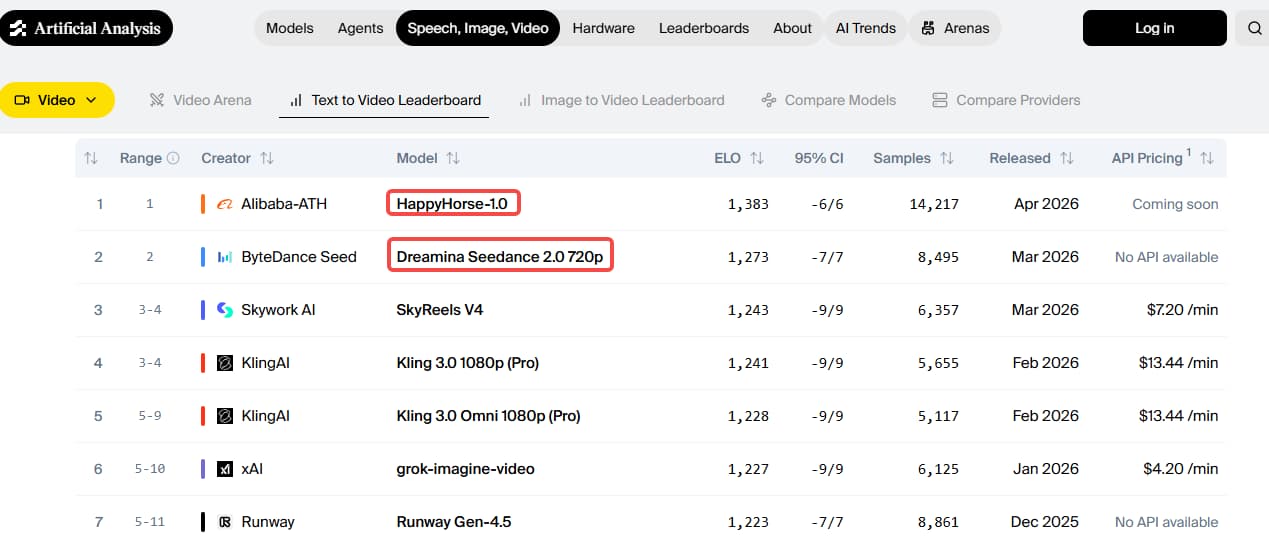
A strong leaderboard position matters. It tells you that blind viewers are responding well to the output. That is part of the story, and it is one reason HappyHorse 1.0 has drawn so much attention so quickly. On the current Artificial Analysis video leaderboard, HappyHorse is clearly carrying stronger public momentum.
But a leaderboard is still a preference signal, not a full workflow verdict. It tells you which outputs people prefer in the arena. It does not fully answer a production question like this: can I keep the same face, the same rhythm, the same action logic, and the same delivery after one more revision?
That is where the comparison becomes more practical than social hype.
HappyHorse 1.0 wins attention because it feels closer to finished video
This is the part many comparisons get right. HappyHorse 1.0 is compelling because it feels built for connected scenes, not just isolated beauty shots. Its appeal is easy to understand: multi-shot flow, stronger first-watch polish, and outputs that already feel close to a cuttable short-form asset.
That public buzz also has a real news hook behind it. TechNode reported that Alibaba confirmed HappyHorse belongs to its ATH unit, which helps explain why the model has been getting so much attention so quickly.
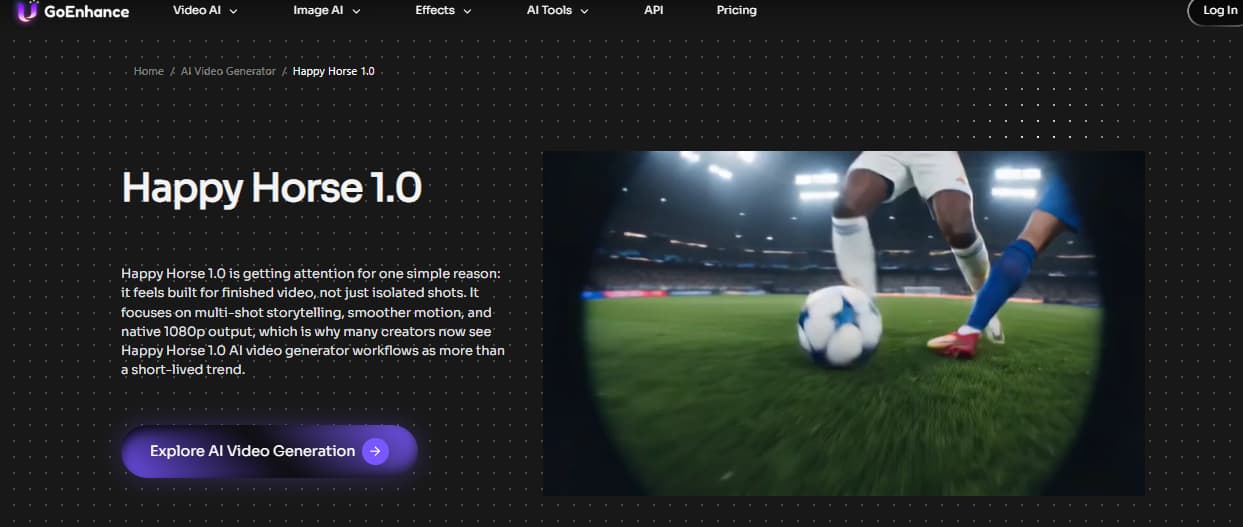
That matters for creators making trailers, short ads, and story-led clips. In those workflows, the model does not need to be perfect at everything. It needs to make a sequence feel finished fast enough to keep momentum. That is a real strength, not just a hype effect.
This is why I would frame HappyHorse this way: it looks especially attractive when the priority is sequence quality at first watch. If the clip lands quickly and already feels polished enough to ship, that is a meaningful advantage.
Seedance 2.0 looks stronger once control starts to matter
This is where I would frame the real difference.
Seedance 2.0 becomes easier to defend when the brief depends on direction, not just generation. The value is not only that it can produce a good-looking clip. The value is that it fits better when you care about dialogue readability, reference-led motion, continuation, and the ability to push a result further without losing the thread.
That positioning also lines up with ByteDance’s own official Seedance 2.0 launch, which leans into controllability, multimodal input, and more directed creative workflows rather than pure one-shot spectacle.
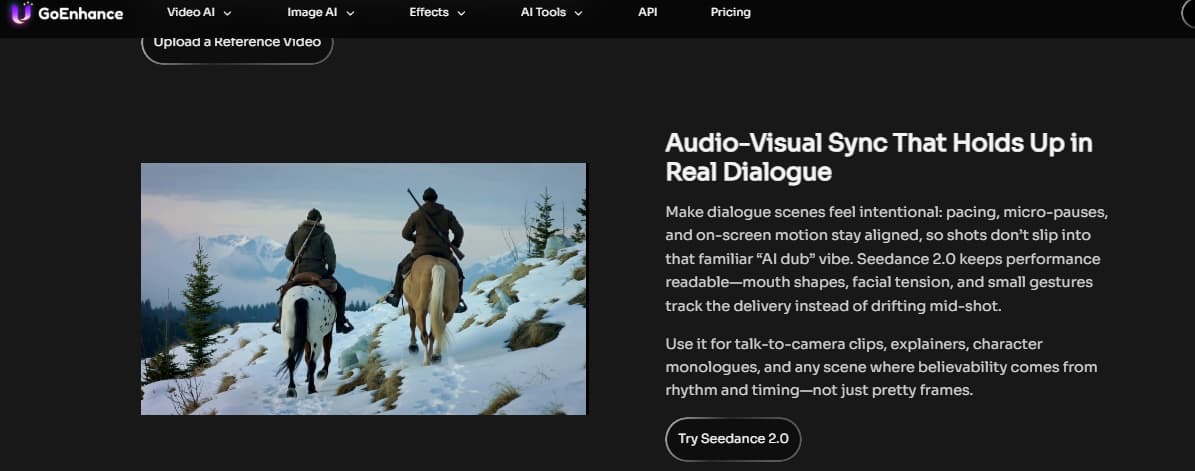
That is why Seedance 2.0 makes more sense for workflows that already look like intentional video creation: talk-to-camera scenes, character beats with timing pressure, shots built from reference material, and revisions where the original visual idea still needs to hold together.
Put more simply: Seedance 2.0 looks especially attractive when the priority is control under iteration. That is not as flashy as a first-pass wow moment, but it becomes more valuable once the work stops being one-shot generation and starts becoming a workflow.
The real gap shows up after the first good-looking clip
A lot of AI video comparisons still behave as if the first render is the whole story. It almost never is.
The harder part is usually the next step: keeping the same character stable, tightening the performance, extending the shot, replacing or adding reference input, or adjusting one element without breaking everything around it. That is where controllability becomes more important than raw first-pass appeal.
This is also the cleanest way to think about the comparison: which kind of pain are you trying to avoid?
If your pain is flat or awkward first-pass output, HappyHorse’s current momentum makes sense. If your pain is revision drift, dialogue timing, or reference-led reshoots, Seedance 2.0 starts to look like the safer working choice.
That is a more useful question than simply asking which model is “better.”
Dialogue scenes and short directed beats reveal more than silent beauty shots
This is probably the clearest practical divider in the comparison.
If the job is a polished short sequence with a strong finished feel, HappyHorse 1.0 has a very intuitive appeal. If the job is a more directed scene where timing, mouth readability, action logic, and audio-visual coherence matter, Seedance 2.0 becomes easier to recommend.
That distinction is also why the same-prompt test matters. A short five-second scene with a speaking moment and multiple physical actions exposes more than a generic cinematic pan ever could. It forces both models to deal with staging, delivery, motion continuity, and visual stability at the same time.
Which one should you choose?
Choose HappyHorse 1.0 when:
- your deliverable is a short ad, teaser, trailer beat, or story-led clip that needs to feel polished quickly;
- you care most about first-pass visual appeal and connected scene flow;
- you are less dependent on deeper reference conditioning or dialogue-sensitive timing.
Choose Seedance 2.0 when:
- the shot needs lip sync, timing, or audio-visual coherence to read as believable;
- you want to guide the result more intentionally instead of only chasing the best first render;
- you expect revisions, extensions, or reference-led changes after the first pass.
If your workflow is closer to “generate something cool,” HappyHorse’s momentum is easy to understand. If your workflow is closer to “direct something usable,” Seedance 2.0 is the stronger starting point.
FAQ
Is HappyHorse 1.0 the better model overall?
Not in a universal sense. It looks stronger when the goal is a polished first-watch sequence. Seedance 2.0 looks stronger when the work starts to depend on control, timing, and follow-up revisions.
Is Seedance 2.0 better for dialogue scenes?
That is the clearer fit. Once spoken beats, mouth readability, and directed performance matter, Seedance 2.0 makes more sense as a working choice.
Why use the same prompt for both models?
Because it removes one of the biggest sources of noise in AI video comparisons. The point is not to give each model a completely different setup. The point is to see how they respond to the same creative demand.
Final take
HappyHorse 1.0 is the more exciting headline right now. Seedance 2.0 is the more defensible choice when the brief starts to look like real direction rather than one-off generation.
That is the distinction I would keep in mind.
If you are making quick, polished story-led clips, HappyHorse deserves the attention it is getting. If you are building videos that need tighter sync, stronger control, and fewer breakdowns once revisions begin, Seedance 2.0 is where the comparison becomes more practical than hype.