
Prompt
Copy and customize
:-
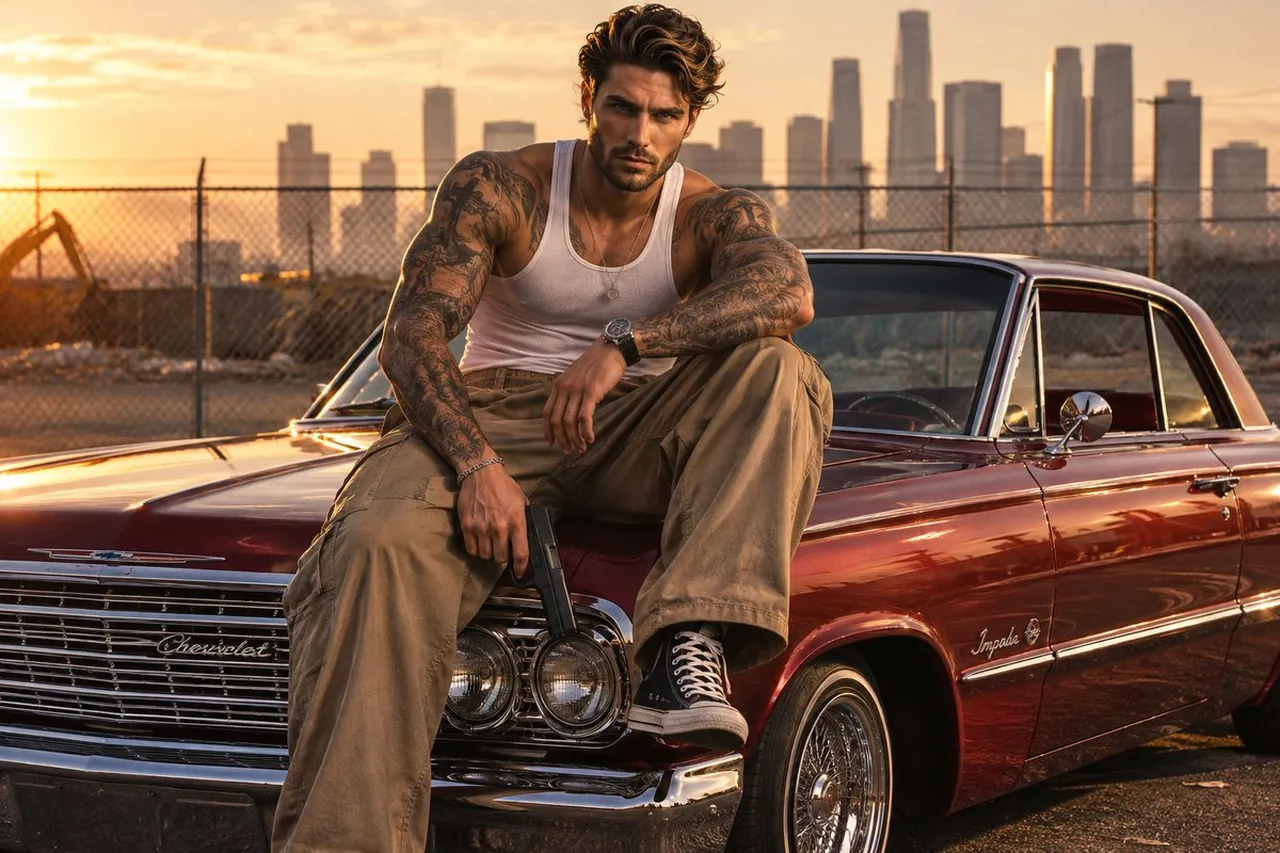
Cinematic wide-angle photograph, taken during golden hour, captures a muscular, tattooed Hispanic man casually seated on the hood of a classic, cherry-red 1960s Chevrolet Impala lowrider. The man is positioned centrally, gazing directly into the camera with a confident, intense expression. He has a shaved head and is dressed in a white ribbed tank top, loose-fitting tan cargo pants, and black and white sneakers. His arms and neck are heavily covered in intricate, detailed black ink tattoos, and in his right hand, resting casually by his knee, he holds a black semi-automatic handgun. The red lowrider, with its gleaming chrome grille and distinctive taillight assemblies, shows off a deep, reflective candy paint finish, indicating quality craftsmanship. He is sitting on the edge of the driver's side hood. The background depicts an open, slightly dusty asphalt parking lot with a chain-link fence running along the middle distance. Beyond the fence, the hazy but recognizable skyline of downtown Los Angeles with its towering skyscrapers rises under a warm, sun-baked, hazy orange sky, suggesting late afternoon heat and light. Debris and distant construction equipment are visible near the city, enhancing the urban, semi-industrial feel. The composition is balanced and powerful, with strong leading lines created by the car and fence. The depth of field is relatively shallow, rendering the city and fence in soft, atmospheric blur, keeping the man and the car's details sharp and in focus. The light is warm, soft, and directional, creating defined highlights and deep, natural-looking shadows that emphasize the man’s muscle tone and the car's curves. The overall image has a rich, film-grain texture, evoking the feel of a 35mm photograph, with natural colors and deep shadows. The shot is well-exposed, capturing detail in both the bright light on the tank top and the darker shadows under the car and fence.
Ideale per
Consigli
Mantieni il soggetto principale focalizzato in modo che la fotografia grandangolare cinematografica scattata durante l'ora d'oro rimanga riconoscibile dopo le modifiche di stile o illuminazione.
Regola l'angolazione della telecamera e le proporzioni prima della generazione quando la composizione richiede un formato specifico per piattaforma.